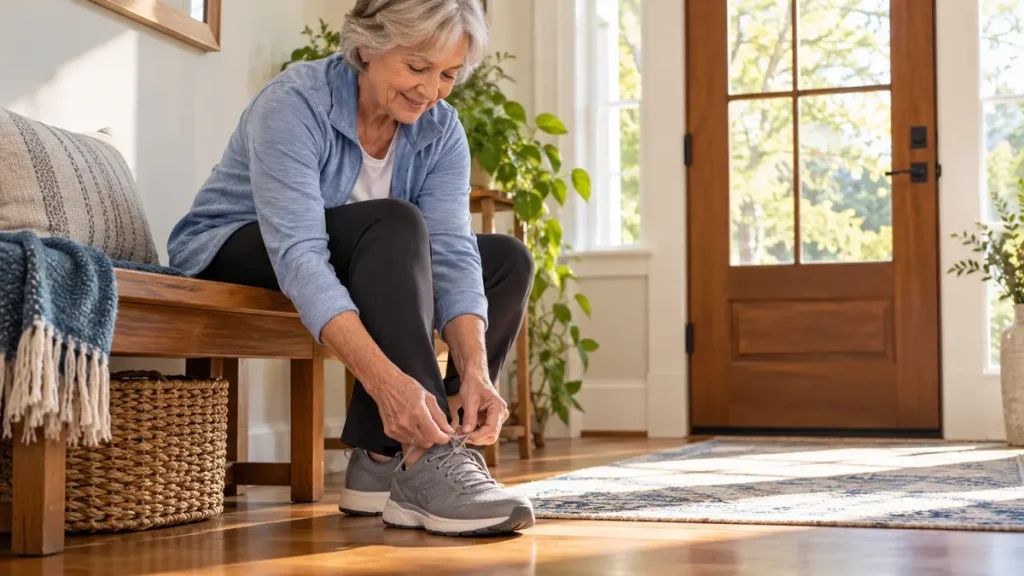
Opening jars, carrying groceries, turning a key, buttoning a shirt, and rising safely with support all depend on the hands. When grip begins to feel less reliable after 60, it is tempting to blame age alone or to buy a stronger squeezing device. A better approach is to look at the whole picture: normal changes in muscle and joints, everyday activity, hand comfort, and warning signs that deserve medical attention. This guide explains what hand strength can and cannot tell you, how to practice safely at home, and when weakness should be evaluated.
Why hand strength can change with age
Hands do not work in isolation. A useful grip depends on finger and thumb joints, forearm muscles, tendons, sensation, coordination, and enough shoulder and trunk stability to position the arm. MedlinePlus notes that aging is commonly accompanied by loss of lean tissue, reduced muscle strength, and stiffer joints. Those changes can be especially noticeable in the hands, but they vary widely from one person to another.
Less use also matters. If pain, illness, recovery from surgery, or a more sedentary routine reduces lifting and carrying, the hands receive fewer reasons to maintain capacity. At the same time, arthritis, tendon irritation, nerve compression, medication effects, or neurological conditions may produce weakness that should not simply be written off as “getting older.”
Hand strength is best treated as a practical ability to maintain, not as a score that defines health or predicts an individual future.
| Possible influence | What it may feel like | Useful next step |
|---|---|---|
| Reduced activity | Both hands tire sooner during ordinary tasks | Resume whole-body and hand activity gradually |
| Joint stiffness or pain | Grip is limited more by discomfort than effort | Discuss persistent symptoms with a clinician or hand therapist |
| Nerve irritation | Numbness, tingling, dropping objects, or night symptoms | Seek an assessment rather than training through symptoms |
| Sudden neurological change | New one-sided weakness or loss of control | Obtain urgent medical help |
What grip strength does and does not measure
Researchers often measure grip with a hand dynamometer because the test is quick and repeatable. In population studies, lower grip strength is associated with poorer function and several health risks. Association, however, is not destiny and does not prove that squeezing harder directly prevents disease or extends life. Height, body size, hand pain, technique, recent injury, and the measuring device can all affect a result.
A 2019 meta-analysis of 24 trials involving community-dwelling adults age 60 and older found that exercise programs produced a small improvement in handgrip strength overall. The authors also cautioned that grip alone does not represent every aspect of functional performance. That is a useful perspective: a grip score can support a broader assessment, but it is not a home diagnosis.
Evidence note: Whole-body resistance and multicomponent exercise matter at least as much as isolated squeezing because everyday hand tasks are supported by the arms, shoulders, posture, balance, and general conditioning.
Start with function, not a maximum squeeze
Before adding exercises, notice what has actually changed. Can you carry a light bag comfortably? Twist a damp cloth without pain? Use cutlery, fasteners, keys, and door handles? Is one hand different from the other? These observations are often more useful than repeatedly testing the hardest possible squeeze.
A simple baseline check
Choose three ordinary tasks that matter to you and rate each as easy, manageable, difficult, or painful. Repeat the same check every few weeks, not every day. The goal is a gradual improvement in control and comfort, not constant testing. Stop a task if it creates sharp pain, persistent tingling, marked swelling, or a feeling that the hand may give way.
| Task | What to observe | Progress sign |
|---|---|---|
| Carry a light grocery bag | Grip comfort, posture, and whether either hand tires early | Same load feels steadier without breath-holding |
| Open a familiar container | Pain, slipping, and need for compensatory twisting | Less strain or better use of an assistive opener |
| Handle buttons or coins | Thumb control, sensation, and coordination | Smoother movement with fewer drops |
Build the foundation with whole-body activity
The Centers for Disease Control and Prevention recommends that adults 65 and older include aerobic activity, muscle-strengthening activity on at least two days each week, and balance work. The World Health Organization likewise recommends muscle strengthening involving major muscle groups on two or more days a week. These are population guidelines, not an individualized prescription, and activity should be adapted to ability and health conditions.
The National Institute on Aging explains that strength training can help maintain physical function and make daily activities such as carrying groceries easier. Activities do not have to happen in a gym. Gardening, carrying appropriately sized household items, resistance-band movements, and selected body-weight exercises can all challenge muscles. For hand function, pulling, rowing, carrying, and controlled lifting expose the grip to useful work while also training the rest of the arm.
- Spread strengthening across the week so tissues have time to recover.
- Use a load you can control without holding your breath or changing posture.
- Increase only one element at a time, such as resistance, repetitions, or duration.
- Keep aerobic, balance, and mobility work in the routine rather than training grip alone.
A gentle hand-strength practice
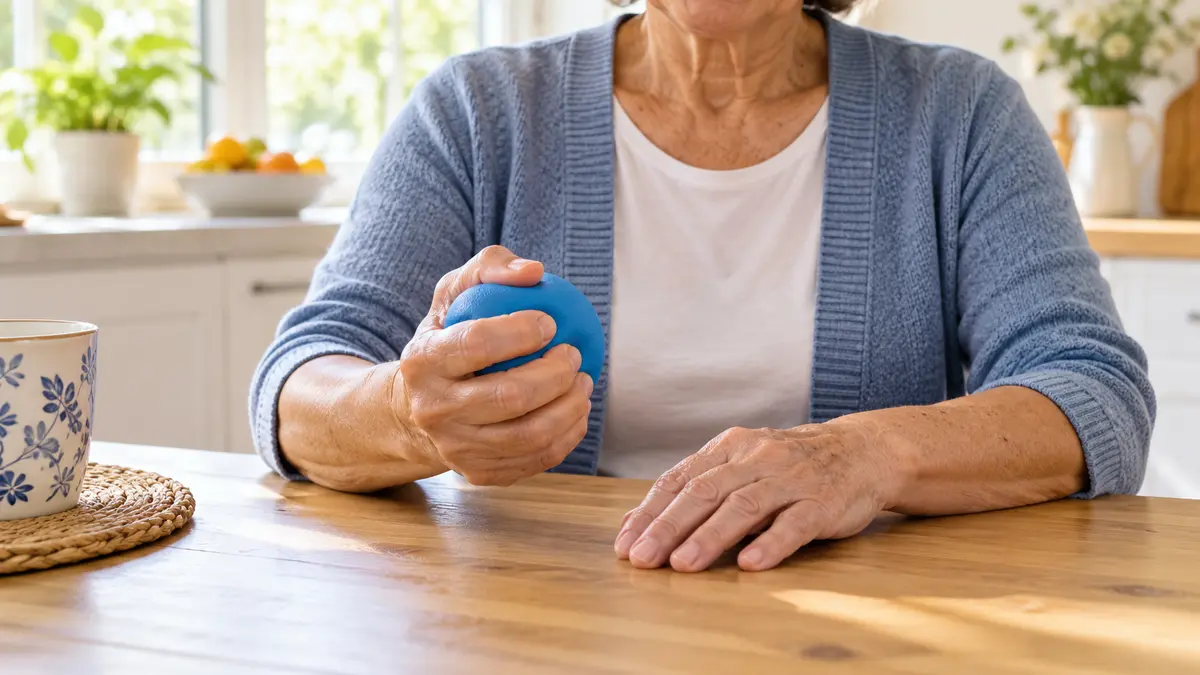
A soft ball, rolled sock, folded washcloth, or soft putty can provide light resistance without expensive equipment. Leeds Teaching Hospitals describes a supported squeeze using a soft compressible object. Their hand exercise was designed for people with hand, thumb, or elbow pain under clinical guidance, so it should not be treated as a universal program. The principles of support, comfort, and gradual progress are broadly useful.
Five-step technique
- Sit upright and support the forearm on a table, cushion, or chair arm.
- Place a soft object in the palm with the wrist in a comfortable, mostly neutral position.
- Squeeze gently and evenly without forcing the finger joints or holding your breath.
- Release fully, relax the hand, and notice whether pain, tingling, or cramping appears.
- Repeat only while the movement remains smooth and comfortable, then practice the other hand.
Begin below your maximum effort. A few well-controlled repetitions are more informative than a long set that causes aching. If a clinician or therapist has given you a specific program, follow that plan instead. People recovering from fracture, tendon injury, surgery, stroke, or significant arthritis should ask about appropriate resistance before starting.
Ways to progress without chasing fatigue
Progress can mean better control, a slightly firmer object, a longer comfortable hold, or adding practical carries. It does not have to mean squeezing until the forearm burns. Allow symptoms to guide the pace. Mild muscular effort that settles promptly is different from joint pain, electrical sensations, numbness, or symptoms that persist after the session.
| Level | Example | Quality cue |
|---|---|---|
| Mobility and control | Open and close the hand slowly; touch thumb to each fingertip | Move through a comfortable range without forcing |
| Light resistance | Gentle squeeze of a rolled sock or soft ball | Keep wrist quiet and breathing normal |
| Functional strength | Carry a light bag or watering can for a short distance | Stay upright and stop before grip becomes unreliable |
| Integrated strength | Supervised rows, pulls, or carries as part of whole-body training | Use controlled form and gradual loading |
Protect joints while you practice
More resistance is not always better. A very stiff gripper can concentrate force in painful finger and thumb joints. Use larger, comfortable handles when possible and avoid prolonged pinching if it aggravates the thumb base. Warming the hands with ordinary movement may make practice more comfortable, but heat should not be applied to an acutely swollen or injured hand unless a clinician recommends it.
Safety note: Exercise should not cause sharp pain, increasing swelling, new numbness, color change, or loss of coordination. Stop and seek professional advice if these occur.
People with rheumatoid arthritis, severe osteoarthritis, osteoporosis affecting the wrist, diabetic neuropathy, recent surgery, or restrictions after injury may need a tailored plan. An occupational therapist, physical therapist, certified hand therapist, or other qualified clinician can help select exercises and adaptive tools.
Make everyday tasks part of training
Formal exercise is only one route to better function. Regular daily tasks can provide low-level practice when they are comfortable and appropriately scaled. The key is to rotate activities so one sore joint or tendon is not loaded repeatedly.
Try carrying a light tote with the wrist straight, wringing a soft sponge gently, clipping clothespins with different fingers, sorting small objects, or gardening with padded handles. Use two hands for heavy cookware and choose jar openers or built-up handles when they reduce pain. Adaptive tools are not a failure; they conserve joints and make it easier to keep participating.
| Daily challenge | Helpful adjustment | Capacity practiced |
|---|---|---|
| Jars and lids | Use a rubber grip mat or opener | Controlled twisting with less joint strain |
| Shopping bags | Split the load between two lighter bags | Carrying endurance and symmetry |
| Kitchen tools | Choose thicker nonslip handles | Grip with less forceful pinching |
| Phone or tablet | Use a stand and alternate hands | Reduces prolonged static gripping |
Recovery, food, and realistic expectations
Muscles adapt during recovery as well as during activity. Sleep, sufficient food, and an overall balanced eating pattern support training, but no supplement or single food can target grip strength on its own. Avoid assuming that weakness requires a high-dose protein, vitamin, or “anti-aging” product. Nutrition needs can change with kidney disease, diabetes, poor appetite, swallowing problems, and medication use, so individualized advice may be appropriate.
Expect progress to be uneven. Hand comfort may improve before maximum strength, and functional gains may show up as fewer dropped objects or less fatigue. A training log can be as simple as the object used, how the movement felt, and whether symptoms lingered. If function continues to decline despite reasonable practice, that is a reason for assessment rather than a cue to push harder.
When hand weakness needs medical attention
Gradual, mild changes can be discussed at a routine appointment, especially when they interfere with cooking, dressing, medication management, or safe use of mobility aids. Seek prompt assessment for worsening numbness, persistent night symptoms, significant swelling, unexplained muscle wasting, or repeated dropping of objects.
New one-sided arm or hand weakness, facial drooping, speech difficulty, severe sudden headache, or a sudden loss of coordination may signal a stroke or another urgent problem. Call emergency services immediately. A fall, deformity, severe pain, open wound, or inability to move the hand after injury also requires timely care.
| Pattern | Possible concern | Response |
|---|---|---|
| Slow change in both hands without pain | Reduced activity or general strength loss | Discuss at a routine visit and begin appropriate gradual activity |
| Numbness or tingling, especially at night | Nerve irritation or compression | Arrange a clinical assessment |
| Hot, swollen, or very painful joint | Inflammation, injury, or infection | Seek prompt medical advice |
| Sudden one-sided weakness with speech or facial change | Possible stroke | Call emergency services immediately |
Bottom line
Hand strength after 60 is useful because it supports independence, not because a single grip score can summarize health. Start with comfortable daily function, include whole-body strengthening, and use light hand resistance with good support and control. Progress gradually, protect painful joints, and treat numbness, sudden weakness, or continuing decline as reasons to seek professional evaluation. General exercise information cannot replace care tailored to your symptoms, diagnoses, medications, and goals.
Sources
- National Institute on Aging: Three Types of Exercise Can Improve Your Health and Physical Ability
- CDC: Older Adult Activity Recommendations
- MedlinePlus: Aging Changes in the Bones, Muscles, and Joints
- World Health Organization: Physical Activity Recommendations
- PubMed: Effects of Exercise Training on Handgrip Strength in Older Adults
- Leeds Teaching Hospitals NHS Trust: Hand Muscle-Strengthening Exercise