Half-used cleaners often accumulate because the safest next step is not obvious. A bottle may be useful, expired, unwanted, leaking, or simply unnecessary, and disposal rules differ by product and community. The practical goal is to prevent accidental exposure at home while keeping reactive, corrosive, toxic, or flammable ingredients out of drains, soil, storm sewers, and inappropriate trash streams. This guide explains how to sort household cleaners, store them temporarily, find local disposal instructions, and reduce future waste without making broad assumptions about what is inside a bottle.
Safety note: Never combine leftover cleaners to save space, and never transfer them into food or drink containers. The U.S. Environmental Protection Agency (EPA) warns that incompatible household hazardous wastes can react, ignite, or explode.
Why household cleaner disposal needs a product-by-product approach
“Cleaner” is a broad category, not a disposal classification. Dish soap, bleach, oven cleaner, drain opener, solvent-based spot remover, disinfectant, and aerosol polish can have very different hazards. The product label is the first source of instructions, but local solid-waste or environmental agencies decide many household disposal options in the United States. A method accepted in one city may be prohibited in another.
The EPA describes household products that are corrosive, toxic, reactive, or capable of catching fire as potential household hazardous waste. Some cleaners fit that description; others do not. That is why universal shortcuts such as “pour it down the sink” or “put every bottle in the trash” are unreliable.
| What you find | Why it matters | Best first action |
|---|---|---|
| Readable label and sound container | Instructions and hazards can still be identified | Keep it closed and follow the label plus local guidance |
| Unknown liquid or missing label | Ingredients and compatibility are uncertain | Do not test, smell, mix, or pour it; ask a local hazardous-waste program |
| Leaking, swollen, rusty, or damaged container | Handling or transport may increase exposure | Isolate people and pets, avoid direct contact, and call local hazardous-materials officials for instructions |
| Empty container with residue | Residual chemical may remain | Check the label and local recycling or waste rules before discarding |
Start with a no-mixing inventory
Before moving anything, look at each container where it is stored. Keep caps closed and labels facing outward. Do not open a product merely to identify it by smell. Separate obviously damaged items from sound containers without allowing liquids to touch. If a container is actively leaking, producing fumes, hot, bulging, or involved in a spill, move people and pets away and seek instructions from emergency services, the fire department, or poison-control professionals as appropriate rather than improvising cleanup.
Read the signal words and disposal directions
Look for warnings such as “danger,” “warning,” “caution,” “corrosive,” “flammable,” or “keep out of reach of children.” Also look for disposal language and a customer-information number. A warning label is not proof that a product must go to a hazardous-waste site, but it is a reason to pause and verify the correct route.
Keep every product identifiable
The U.S. Consumer Product Safety Commission (CPSC) advises storing household chemicals in their original child-resistant containers and out of children’s reach. Original packaging helps preserve the ingredient identity, warnings, first-aid information, and closure designed for that product. A beverage bottle, jar, or unmarked spray bottle removes those protections and can be mistaken for something safe.
The safest disposal process preserves information first: keep the label, keep the cap, keep products separate, and let verified local instructions determine the destination.
Match the item to the right disposal route
Use the label and your local government’s solid-waste, public-works, environmental-health, or household hazardous-waste website together. Search for an official page tied to your municipality, county, or state. If instructions conflict or the product is not listed, call the program and describe the product type, container condition, and approximate amount. Do not assume that a wastewater system, septic system, curbside program, or recycling facility can accept a chemical merely because the container is small.
| Possible route | Use it when | Verification needed |
|---|---|---|
| Household hazardous-waste facility or event | The label or local program identifies the cleaner as hazardous, reactive, corrosive, toxic, or flammable | Accepted product list, hours, quantity limits, and transport rules |
| Manufacturer or retailer take-back | A verified program accepts that exact product category | Eligibility, packaging, and location requirements |
| Household trash | The product label and local authority both allow it | Whether the product must be empty, solidified, bagged, or left in its container |
| Container recycling | The container type is accepted and residue requirements are met | Local recycling rules and label directions; never rinse a hazardous product unless instructed |
Practical rule: A drain, toilet, street gutter, yard, or storm sewer is not a default disposal route. EPA notes that improper disposal can harm sanitation workers, contaminate septic or wastewater systems, threaten children and pets, and pollute the environment.
Prepare cleaners for temporary storage and transport
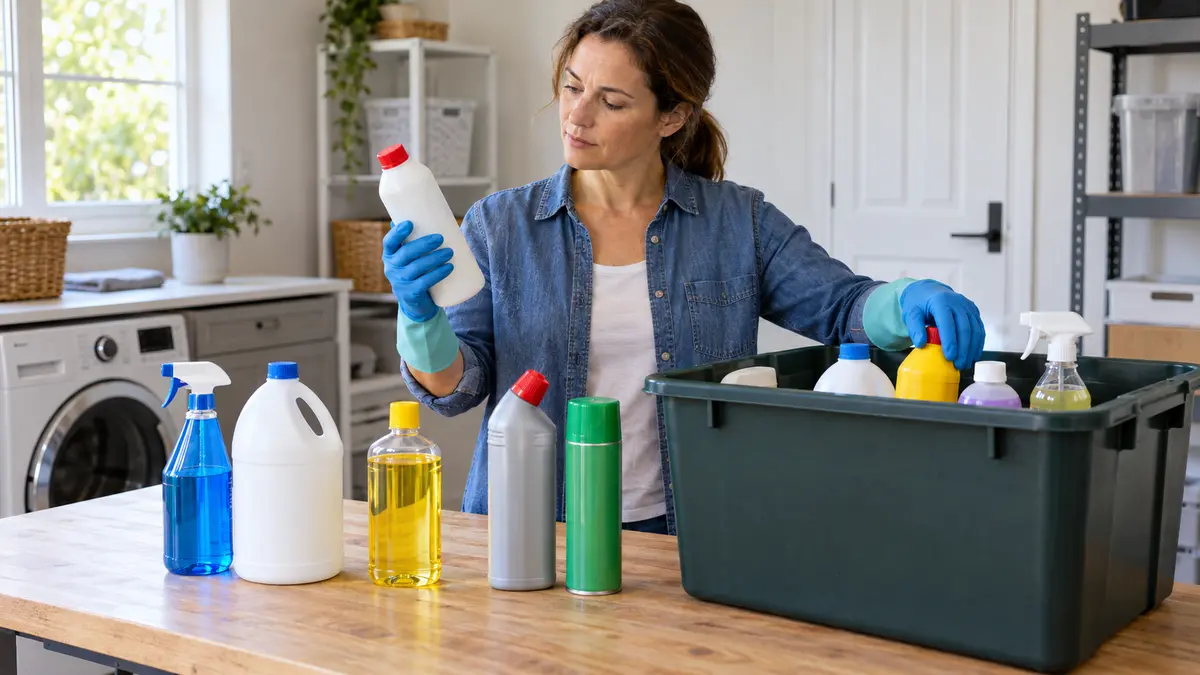
When a collection appointment or event is required, temporary storage matters. Keep products upright in their original containers, with caps secured. Use a sturdy plastic bin or tray to contain a leak, but do not pour products into the bin or combine them. Place incompatible types apart. Keep the bin in a secure, ventilated location away from heat, flames, food, medicine, children, and pets.
- Confirm the collection program accepts each product before loading the vehicle.
- Check every cap and keep the original label visible.
- Place containers upright in a rigid bin; use separate bins if the program recommends segregation.
- Prevent tipping during the drive and keep products out of the passenger area when feasible.
- Travel directly to the site and follow staff directions on arrival.
Do not tape over a leak or repackage a failing container unless the receiving program specifically tells you how. EPA advises contacting a local hazardous-materials official or fire department for corroding containers because they require special handling.
Prevent exposures while the products are still at home
Disposal may take days or weeks, so the holding period should be treated as part of the safety plan. Lock cleaners away or place them in a secured cabinet that children cannot reach. Keep laundry packets and concentrates in their original containers. Do not store household chemicals beside drinks, ingredients, pet food, or medicines.
Ventilate during normal use, not by leaving containers open
Ventilation means bringing in outdoor air or using an appropriate exhaust fan while using a product according to its label. It does not mean loosening caps in storage. The joint EPA and CPSC indoor-air guide notes that cleaning and maintenance products can contribute gases or particles indoors and that inadequate ventilation can allow pollutants to accumulate. Close containers promptly after use.
Never mix bleach with another cleaner
The Centers for Disease Control and Prevention says never to mix household bleach or disinfectants with other cleaners or disinfectants because dangerous vapors can be released. It also recommends good ventilation and following product directions. If an accidental combination produces fumes or someone develops trouble breathing, severe eye irritation, confusion, collapse, or another serious symptom, leave the area and seek urgent professional help. In the United States, Poison Help is available at 1-800-222-1222; call emergency services for life-threatening symptoms.
| Unsafe shortcut | Safer replacement | Reason |
|---|---|---|
| Combining partial bottles | Keep each product separate in its labeled container | Unknown combinations can release heat, gas, or other hazards |
| Using a drink bottle for storage | Retain the original child-resistant package | Reduces mistaken ingestion and preserves warnings |
| Opening a bottle to smell it | Use the label and ask the disposal program | Smelling increases exposure and does not reliably identify contents |
| Rinsing every container for recycling | Check product and local instructions first | Rinsing may create an unsafe wastewater discharge or reaction |
Reduce cleaner waste before it starts
The lowest-risk waste is often the product that was never overbought. Take a quick inventory before shopping, choose an amount you can realistically use, and avoid buying several specialized cleaners when one suitable product will do. Follow dilution directions rather than assuming that more product cleans better. Store products correctly so caps, labels, and containers remain usable.
For routine surface cleaning, the CDC notes that soap and water can remove germs in most situations and that disinfection at home is generally most relevant when someone is sick or has recently visited while sick. That distinction can reduce unnecessary disinfectant use without lowering routine cleanliness.
- Choose the smallest practical package for infrequently used products.
- Write the purchase month on a removable shelf tag rather than altering the safety label.
- Use older sound products first when their labels allow continued use.
- Avoid vague “green” claims; look for transparent, credible certification.
- Share unopened products only when the label permits it and the recipient can store and use them safely.
What the EPA Safer Choice label can and cannot tell you
EPA’s voluntary Safer Choice program evaluates every intentionally added ingredient against human-health and environmental criteria. It also reviews performance, packaging, pH, and volatile organic compound limits. The label can help shoppers identify products formulated with ingredients that meet those criteria, and certified products must meet performance standards.
However, “safer” does not mean risk-free, edible, appropriate for every person, or acceptable in every disposal stream. Users still need to follow the product label, protect eyes and skin when directed, ventilate appropriately, and keep the container away from children. People with asthma, fragrance sensitivity, skin disease, or other health concerns may need individualized guidance from a clinician or occupational-health professional.
A five-minute decision checklist
When you discover an unwanted cleaner, use this sequence:
- Identify: Is the original label readable and the container sound?
- Stabilize: Close the cap, keep the product upright, and secure it away from children, pets, heat, and food.
- Classify: Read hazard and disposal language without opening, testing, or smelling the contents.
- Verify: Check an official local waste authority and confirm acceptance details.
- Transport or discard: Follow the exact product and local instructions; do not substitute a convenient route.
If any step is uncertain, stop at secure storage and ask the relevant local authority. General information cannot account for a product’s formulation, a damaged container, a home’s septic system, or local law.
Bottom line
Safe household cleaner disposal is less about memorizing one rule than following a reliable process. Keep products in original labeled containers, never mix leftovers, protect children and pets, and verify the disposal route with the label and local authority. Household hazardous-waste programs are often the appropriate destination for cleaners that are corrosive, toxic, reactive, or flammable. Buying only what you need and choosing credible safer-product labels can reduce the number of difficult leftovers next time.
Sources
- U.S. Environmental Protection Agency: Household Hazardous Waste
- Centers for Disease Control and Prevention: Cleaning and Disinfecting With Bleach
- U.S. Consumer Product Safety Commission: Poison Prevention
- U.S. Environmental Protection Agency: Learn About the Safer Choice Label
- U.S. Consumer Product Safety Commission and EPA: The Inside Story, a Guide to Indoor Air Quality