Synthetic fleeces, workout clothes, and many everyday fabrics can release tiny fibers when they are washed. Some are plastic-based microfibers that can travel from laundry wastewater into the wider environment. That does not mean one load of laundry is a personal health emergency, and it does not mean every synthetic garment should be thrown away. A more useful response is to understand which actions are practical, which claims are still uncertain, and how to care for clothing in ways that reduce waste as well as fiber loss.
This guide explains how laundry microfibers are released, what current research says about wash settings and filters, and how to build a lower-impact routine without sacrificing basic hygiene or damaging clothes. It focuses on household decisions rather than exaggerated claims about eliminating microplastics.
What laundry microfibers are
Microfibers are small, thread-shaped fragments shed from textiles. Synthetic fabrics such as polyester, nylon, and acrylic can release plastic microfibers. Cotton, wool, rayon, and other materials also shed fibers, although their chemistry and environmental persistence differ. The term microfiber therefore describes shape and size, while microplastic fiber refers specifically to a plastic-based fiber.
The National Oceanic and Atmospheric Administration overview of microplastics identifies synthetic textiles as one source of microfibers entering wastewater. The U.S. Environmental Protection Agency microfiber pollution resource likewise explains that clothing can contribute fibers to waterways.
Laundry microfiber reduction is best treated as a practical pollution-prevention habit: lower avoidable shedding, keep useful clothes in service, and avoid turning uncertain evidence into a health scare.
| Fiber or fabric type | What may be shed | Practical implication |
|---|---|---|
| Polyester, nylon, acrylic | Plastic-based microfibers | Prioritize gentle care and consider capture methods for frequently washed synthetics |
| Cotton and wool | Natural fibers, sometimes with dyes or finishes | Do not assume “natural” means no shedding; focus on garment durability |
| Rayon and other regenerated cellulose | Human-made cellulose-based fibers | Treat fiber labels as one factor rather than a complete environmental score |
| Blended fabrics | A mixture reflecting their components and construction | Care instructions and fabric quality may matter more than a simple label |
Why washing sends fibers into wastewater
Water flow, tumbling, rubbing, fabric construction, garment age, and the condition of a textile can all influence shedding. A washer does not create every loose fiber from scratch; it also removes fibers already loosened during manufacture and wear. New garments may shed more during early washes, while worn or damaged fabrics can shed as their structure deteriorates.
A controlled PLOS ONE study of consumer apparel textiles found wide variation across fabrics and constructions. It also found that both synthetic and natural textiles released fibers. This makes a simple “one fiber is always best” rule difficult to defend. The European Environment Agency’s briefing on microplastics from textiles emphasizes that releases occur across production, use, washing, and disposal, not only inside the home.
Evidence note: studies use different garments, machines, filters, water volumes, and counting methods. Exact shedding numbers from one experiment should not be treated as a prediction for every household load.
Start by washing less often, when hygiene allows
The most direct way to avoid wash-related shedding, water use, and energy use is to skip unnecessary cycles. That does not mean wearing visibly dirty or unhygienic clothes. Underwear, socks, exercise clothing, items exposed to bodily fluids, and garments used during illness may need prompt washing. In contrast, an outer sweater, trousers, or a jacket worn briefly may only need airing, spot cleaning, or another wear.
Use a simple pre-wash check
- Look for visible soil, stains, or dampness.
- Consider whether the garment was worn close to the skin or during heavy sweating.
- Check whether someone in the household is ill or has specific infection-control instructions.
- Air the item when it is clean but has a mild storage or cooking odor.
- Spot-clean a small mark when the care label permits it.
This approach can extend garment life, but hygiene takes priority when contamination is plausible. People with immune compromise or clinical laundry instructions should follow guidance from their healthcare team rather than a general sustainability routine.
Choose wash settings that serve both clothes and cleanliness
Research does not support a universal setting that minimizes shedding for every fabric. However, a full but not overstuffed load and a cycle no longer or harsher than necessary are reasonable starting points. A PLOS ONE study using real soiled consumer laundry found lower fiber release with larger complete loads than with small loads under the tested conditions. It also found that colder, quicker cycles reduced microfiber release while maintaining the study’s cleaning performance measures.
The ENERGY STAR clothes washer guidance recommends full loads when possible and notes that cold water generally cleans ordinary laundry well, while recognizing exceptions such as oily stains and household illness. Always follow the garment label, washer instructions, detergent directions, and any health-specific advice.
| Decision | Lower-impact default | When to choose differently |
|---|---|---|
| Load size | A complete load with room for items to move | Use a smaller load for care-label needs, color transfer, or heavily soiled items |
| Water temperature | Cold when it cleans effectively | Use warmer settings when the label, stain, illness, or professional guidance calls for it |
| Cycle length | The shortest suitable cycle | Use longer or intensive cycles for genuinely heavy soil when instructions allow |
| Spin and agitation | Gentle enough for the fabric and soil level | Increase only when needed for cleaning or moisture removal |
Do not overfill the drum
A complete load is not a compressed load. Clothes still need enough space for water and detergent to circulate. Overfilling can reduce cleaning, leave residue, strain the machine, and encourage repeat washing. Use the appliance manual’s load guidance rather than a rigid household rule.
Detergent, softener, and laundry add-ons
Detergent is necessary for many soils, but adding more than directed does not guarantee cleaner clothes. Excess product can be hard to rinse and may encourage another cycle. Use the amount recommended for the load size, soil level, machine type, and water hardness.
Findings on detergent type and fiber release are inconsistent. Some laboratory studies report differences between powder and liquid products, while other work finds little or no effect under realistic conditions. The real-load PLOS ONE study found no significant direct effect from the detergent pod or fabric softener it tested. That result does not prove all formulations behave identically.
Practical note: do not add vinegar, essential oils, disinfectants, or homemade chemical mixtures to a washer unless the appliance and product instructions explicitly allow them. Never mix bleach with ammonia, acids, or other cleaners. Environmental goals do not justify chemical exposure, damaged seals, or unsafe fumes.
Keep garments useful for longer
Buying fewer items and using them longer can reduce repeated first washes, replacement demand, and textile waste. The goal is durability, not a perfect fiber wardrobe. A well-used synthetic jacket may be a better practical choice than discarding it for a newly purchased alternative.
Read and follow the care label
The Federal Trade Commission’s care-label guidance explains that clothing labels provide regular washing or dry-cleaning instructions and warnings intended to prevent damage. Following those instructions helps avoid shrinkage, coating damage, color transfer, and premature wear.
- Repair small holes, loose seams, and broken fasteners before washing when practical.
- Close zippers and fasteners that could abrade delicate fabrics.
- Turn printed or textured garments inside out if the care label supports it.
- Separate rough items from delicate knits when friction could cause damage.
- Air-dry when suitable for the garment and household conditions.
- Store clothing clean and dry to prevent odor, mildew, and avoidable rewashing.
Replacement is appropriate when an item no longer performs safely, cannot be cleaned, or is too damaged to use. Donate only clean, functional clothing that another person could reasonably wear; damaged textiles may need a local textile-recovery program rather than a charity bin.
Do microfiber bags, balls, and washer filters help?
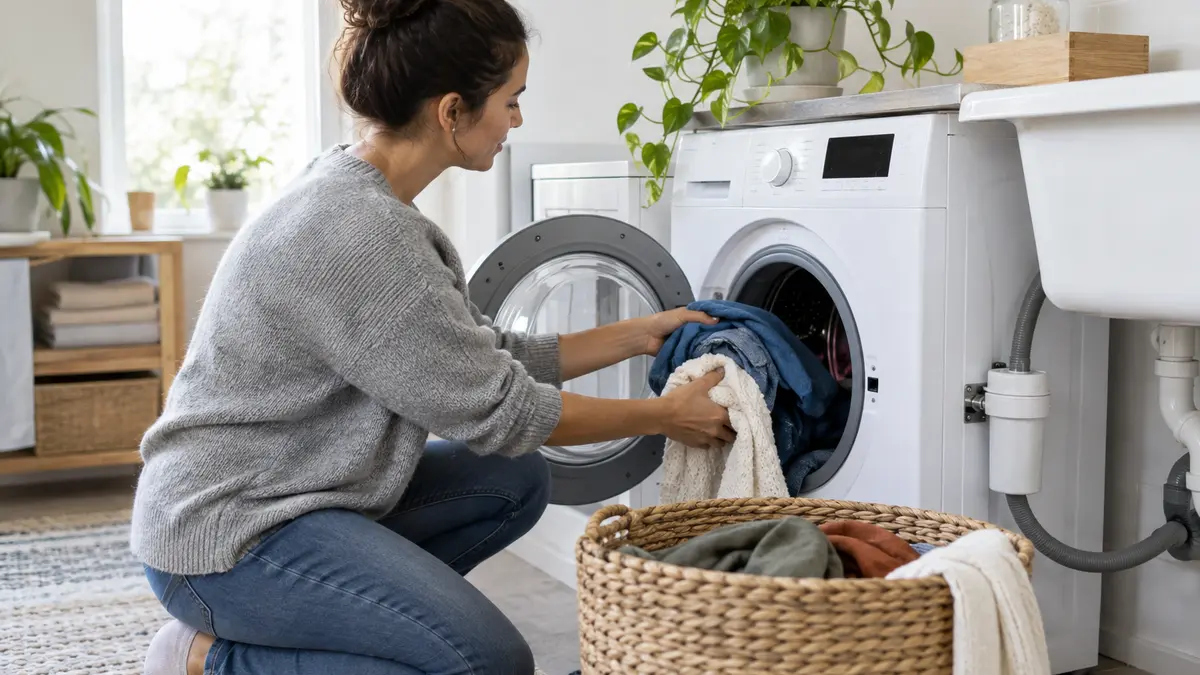
Capture devices aim to keep fibers out of wastewater. They vary in design and evidence. External washer filters can collect lint from drain water, while in-drum bags or balls interact with garments inside the machine. No device captures every fiber, and performance in a laboratory may not match every home.
A community-scale pilot published in Frontiers in Marine Science installed external filters in 97 homes and reported microfiber capture plus a reduction in fibers measured in treated wastewater after deployment. The authors also noted limitations, including possible behavior changes in the community and uncertainty about how results would transfer elsewhere.
| Option | Potential advantage | Important limitation or task |
|---|---|---|
| External washer filter | Captures fibers before drain water reaches the sewer | May require plumbing, space, routine cleaning, and flood-safe installation |
| Built-in machine filter | Integrates capture into appliance design | Availability and maintenance requirements vary |
| In-drum washing bag | Low-cost option for selected synthetic items | Capacity, cleaning effect, and capture performance differ by product and load |
| Laundry ball or similar device | Simple to add to a load | Evidence and capture efficiency are variable; loose devices may not suit every machine |
If installing an external filter, follow the washer manufacturer’s guidance and use a qualified installer when plumbing changes are involved. Clean the unit at the recommended interval, keep collected lint out of sinks and toilets, and place it in household trash unless local instructions provide another route. A clogged or incorrectly fitted drain accessory can cause leaks or appliance damage.
A realistic lower-shedding laundry routine
A good routine should be easy enough to repeat. Start with actions that also save energy, water, clothing, or time. Specialized capture equipment can be considered after the basics, especially in a household that washes many synthetic fleeces, athletic garments, or uniforms.
| Priority | Action | Why it earns that place |
|---|---|---|
| First | Wash only when needed and follow care labels | Reduces unnecessary cycles and protects garment life |
| Second | Use complete, not overstuffed, loads | Improves resource efficiency and may reduce fiber release per garment |
| Third | Choose cold, appropriately short cycles when suitable | Can reduce energy use and may reduce wear under some tested conditions |
| Fourth | Repair, rewear, and avoid premature replacement | Addresses impacts beyond the washing machine |
| Fifth | Evaluate a compatible capture device | May intercept fibers but adds cost and maintenance |
Try one change for a month
Choose one habit, such as waiting for a complete load or using the shortest suitable cold cycle. Mark it on a laundry note for four weeks. If clothes remain clean, the machine runs well, and the routine feels manageable, keep it. Then consider a second step. This avoids buying a gadget before understanding what the household actually needs.
What this routine cannot promise
No household laundry practice can eliminate microfiber pollution. Fibers can be released during textile manufacturing, everyday wear, drying, and disposal. Wastewater treatment captures a portion but not necessarily all fibers, and captured material can move into sludge. Larger changes in textile design, appliance standards, wastewater treatment, and product policy are therefore important alongside individual choices.
Human exposure to microplastics is an active research area, but the health effects of a particular laundry routine cannot currently be quantified for an individual. Avoid claims that a filter, fabric, or wash bag will “detox” a home or prevent disease. The established reason for the actions in this guide is environmental source reduction and clothing longevity, not a guaranteed medical benefit.
People with severe allergies, skin conditions, infection-control needs, occupational contamination, or immune compromise may need laundry practices tailored by a clinician or workplace safety program. Do not lower a medically necessary wash temperature or skip required decontamination to reduce microfiber shedding.
Bottom line
Laundry releases fibers from both synthetic and non-synthetic textiles, and plastic-based microfibers are one pathway of microplastic pollution. The most useful household response is measured: wash garments only when they need it, use a complete but not overfilled load, choose a suitable cold and shorter cycle when care and hygiene allow, maintain clothing, and avoid premature replacement.
External washer filters have promising evidence for capturing fibers, but they require compatible installation and maintenance and are not a complete solution. Start with no-cost habits, protect hygiene and garment care, and treat specialized products as optional tools rather than miracle fixes.
Sources
- U.S. EPA: What You Should Know About Microfiber Pollution
- NOAA National Ocean Service: Microplastics overview
- European Environment Agency: Microplastics from textiles
- PLOS ONE: Microfiber release from real soiled consumer laundry
- PLOS ONE: Domestic laundry and microfiber pollution
- Frontiers in Marine Science: Washing machine filters community pilot
- ENERGY STAR: Clothes washer best practices
- Federal Trade Commission: Clothing care-label guidance