Most fall-prevention advice sounds simple: remove clutter, improve lighting, and add support where surfaces become slippery. The challenge is turning those ideas into a home that is safer without making it feel clinical or restrictive. This room-by-room guide explains which changes deserve priority, how to review the less obvious personal factors that contribute to falls, and when professional help is worth seeking.
Falls are not an inevitable part of getting older. Risk usually comes from several factors working together, such as reduced balance, a medicine that causes dizziness, dim stairs, or a rushed trip to the bathroom at night. A practical plan therefore combines safer surroundings with health review, appropriate activity, and a reliable way to call for help.
A safer home is not one with zero movement; it is one that makes everyday movement clearer, steadier, and easier to recover from.
Why home fall prevention matters after 60
Many people spend a large share of the day at home and move through familiar rooms on autopilot. Familiarity can hide risks: the rug that has curled gradually, the hallway light that no longer reaches the floor, or the frequently used pan stored above shoulder height. The National Institute on Aging room-by-room guidance emphasizes clear paths, secure floor coverings, good lighting, grab bars, and reachable storage.
The consequences of a fall can extend beyond the first injury. Pain, fear of another fall, and reduced activity can make strength and confidence decline. The Centers for Disease Control and Prevention recommends a combination of medical risk review, strength and balance activity, vision care, and home changes. That combination matters because fixing one loose rug will not correct dizziness, and improving balance will not make a dark staircase visible.
Evidence note: home changes are most useful when they respond to a person’s actual risks and are part of a broader plan. They should not be presented as a guarantee that no fall will occur.
Start with a short, systematic home walk-through
Choose a calm time in daylight, then walk the routes used most often: bed to bathroom, favorite chair to kitchen, front door to living area, and any path involving stairs. Repeat the review after dark because lighting problems can disappear during the day. If possible, ask another person to join you; someone who does not live in the home may notice obstacles that have become familiar.
Use movement, not appearance, as the test
A room can look tidy and still be awkward to navigate. Notice whether you need to sidestep furniture, reach for unstable surfaces, carry objects that block your view, or hurry before a light switches off. Check whether doors, drawers, or pet supplies narrow the walking path. Wear the footwear normally used at home during the review.
- Trace the four most-used routes in the home.
- Mark every place where lighting, footing, or support feels uncertain.
- Fix quick hazards immediately, such as a cord across a path.
- List repairs or installations that require tools or professional help.
- Repeat the check after a fall, a move, a new mobility problem, or a major medication change.
| What to observe | Questions to ask | Useful first response |
|---|---|---|
| Walking path | Do I turn sideways or step around objects? | Reposition furniture and remove cords, shoes, and low clutter. |
| Lighting | Can I see floor edges and changes in level? | Add brighter, glare-controlled light and accessible switches. |
| Footing | Does anything slide, curl, or become slick? | Remove loose rugs; secure flooring and use nonslip wet-area surfaces. |
| Support | Am I grabbing a towel bar, door, or furniture? | Install properly anchored rails or grab bars in the needed location. |
Make floors, halls, and stairs easier to navigate
Clear walking space is the foundation of a safer home. Remove small rugs when practical; tape alone may not correct a rug that wrinkles or curls. Secure carpet edges, repair uneven thresholds, and route electrical cords along walls rather than across traffic areas. Furniture should leave enough room for a natural stride and for any cane or walker a clinician has recommended.
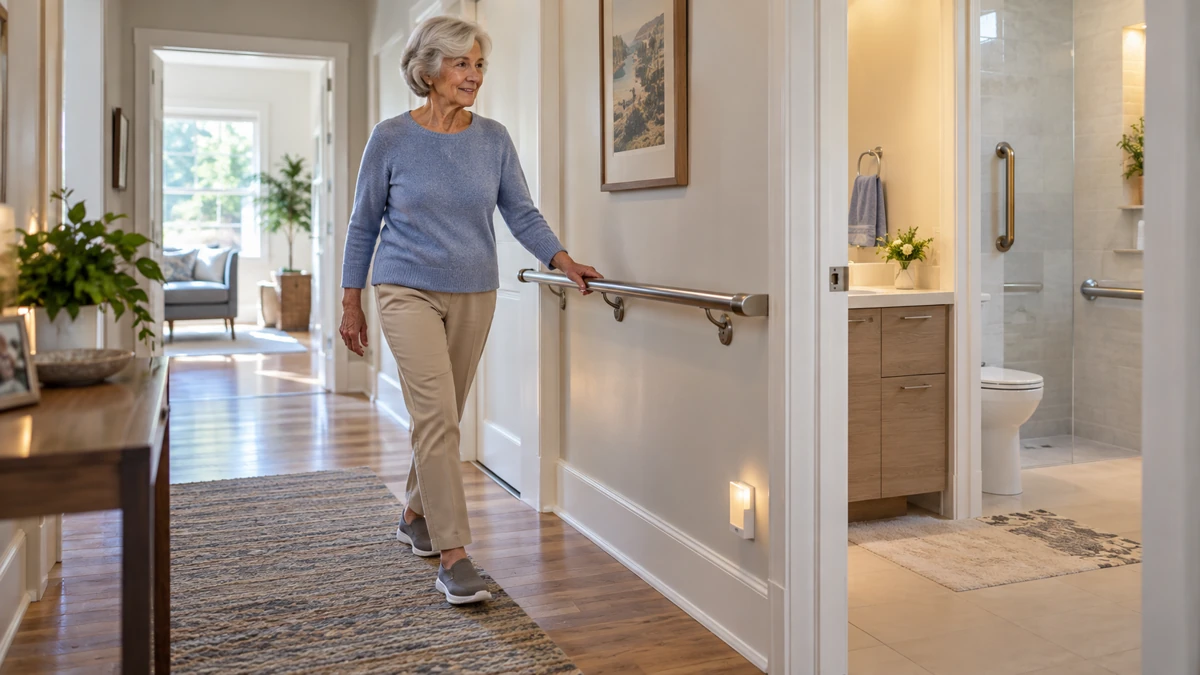
Stairs need special attention. Rails on both sides offer options when one hand is weaker or when direction changes. Steps should be even, uncluttered, and clearly visible. Place switches at both ends of the stairway so nobody has to enter darkness to reach the light. Contrast at step edges may help some people, but highly patterned flooring can create visual confusion.
Choose lighting that reveals rather than dazzles
More light is not always better if it produces glare. Use shaded fixtures, replace failed bulbs promptly, and reduce strong reflections from polished floors. Motion-activated night lights can illuminate the bedroom-to-bathroom route, but they should switch on before a person reaches an obstacle. Keep a charged phone and a flashlight near the bed in case power fails.
| Area | Common hazard | Safer setup |
|---|---|---|
| Hallway | Low table, cords, dim corners | Continuous clear path, wall-routed cords, even lighting |
| Stairs | One rail, objects on steps, poor contrast | Secure rails on both sides, empty steps, visible edges |
| Doorways | Raised or damaged threshold | Repair or clearly mark level changes and keep doors fully open |
| Bedroom route | Dark path and loose footwear | Night lighting, clear floor, shoes placed within easy reach |
Prioritize the bathroom
Water, smooth surfaces, tight spaces, and repeated sitting and standing make bathrooms a high-priority zone. Use nonslip surfaces inside and outside the shower or tub. Install grab bars where support is needed near bathing and toilet areas; towel bars are not designed to hold body weight. A qualified installer should fasten supports to the correct structure rather than relying on suction alone for weight-bearing help.
A shower chair, hand-held shower, or toilet-height modification may help some people, but fit matters. Equipment that is the wrong height or that shifts during use can add risk. An occupational therapist can evaluate the room and the person’s movement pattern. Keep toiletries reachable without bending deeply, twisting, or standing on a stool.
Safety note: new weakness, fainting, severe dizziness, sudden vision change, chest pain, breathing difficulty, or a fall with head injury requires prompt medical assessment. Call emergency services for urgent or life-threatening symptoms.
Set up the kitchen and living areas for everyday reach
Store frequently used dishes, cookware, and food between roughly waist and shoulder height. This reduces the need to climb, stretch overhead, or crouch. Clean spills promptly and keep a stable place to sit if meal preparation causes fatigue. Avoid using chairs or tables as ladders; a reach tool or help from another person is safer for occasional high items.
In living areas, check that chairs are stable and high enough to stand from without pulling on a light table. Remove wheels from furniture that is used for support. Arrange phone chargers so cords do not cross the floor. Pet bowls, toys, and sleeping spots should sit away from main routes, especially the route used at night.
| Priority | Low-cost action | When specialist input helps |
|---|---|---|
| Immediate | Clear walkways, wipe spills, replace failed bulbs | Repeated falls or uncertainty about why falls occur |
| Next weekend | Reorganize storage and secure loose flooring | Difficulty reaching, standing, or transferring safely |
| Planned improvement | Add rails, grab bars, or better fixtures | Choosing placement, height, anchoring, or adaptive equipment |
| Ongoing | Review footwear, vision, medicines, and activity | Dizziness, weakness, new symptoms, or medication concerns |
Look beyond the house: medicines, vision, and health
A home audit cannot identify every fall risk. Some prescription and nonprescription medicines can contribute to sleepiness, dizziness, low blood pressure, or confusion, especially when several are used together. Ask a clinician or pharmacist for a complete review, including over-the-counter products and supplements. Do not stop or change a medicine on your own because of fall concerns.
Vision and hearing changes can affect depth, contrast, orientation, and awareness of surroundings. Keep examinations current and allow time to adapt to a new glasses prescription. Rising slowly may help when lightheadedness occurs with position changes, but recurrent dizziness or near-fainting deserves clinical evaluation. Foot pain, numbness, weakness, continence urgency, and sleep problems can also affect how a person moves through the home.
Know when a professional home assessment adds value
Consider asking about occupational therapy, physical therapy, nursing, or another qualified home-safety service after a fall, when mobility changes, or when it is unclear which modification would help. The MedlinePlus fall-prevention overview notes that a provider can advise about home safety, strength and balance, and appropriate use of a cane or walker. A mobility aid should be fitted and taught, not borrowed casually.
Build strength and balance without creating new risk
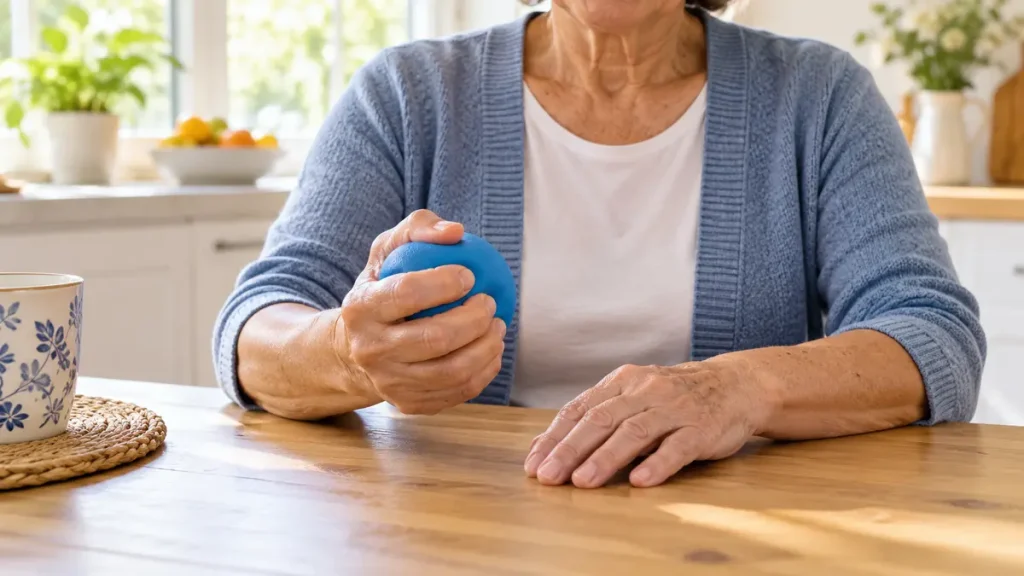
Environmental changes reduce hazards, but maintaining the ability to recover from a trip matters too. The U.S. Preventive Services Task Force recommendation supports exercise interventions for community-dwelling adults age 65 and older who are at increased risk of falls. Programs in the evidence commonly include gait, balance, functional, and strength training.
The right starting point depends on current ability, health conditions, prior falls, and symptoms. Someone who is unsteady, has recently fallen, or uses a mobility aid may benefit from an assessment and supervised program. Activity should be progressive and challenging enough to improve function, but not improvised beside unstable furniture or on slippery floors.
- Choose a clear, well-lit practice area.
- Use prescribed support and well-fitting footwear.
- Stop and seek guidance for chest pain, faintness, unusual shortness of breath, or new neurological symptoms.
- Favor regular practice over occasional exhausting sessions.
- Ask about evidence-based community programs or physical therapy when risk is elevated.
Plan what happens if a fall occurs
Prevention also includes a response plan. Carry a charged phone rather than leaving it in another room. Save emergency contacts and make the home address easy to find. A personal emergency response device may be useful for someone who lives alone or cannot reliably reach a phone, but features, monitoring fees, cellular coverage, charging needs, privacy, and false alarms vary.
After a fall, do not rush to stand if there may be an injury. Seek urgent help for a head impact, severe pain, deformity, heavy bleeding, loss of consciousness, new confusion, weakness, numbness, or inability to bear weight. Even without obvious injury, tell a clinician about a fall or repeated near-falls; they can signal a modifiable problem. Fear after a fall is understandable, but avoiding all movement can worsen conditioning, so a supported return to appropriate activity may be important.
A practical 30-minute fall-prevention reset
Not every improvement requires renovation. A short reset can remove immediate hazards while creating a list for larger work. Start with the route most likely to be used when tired or distracted, usually the bedroom-to-bathroom path, then continue to the kitchen and entry.
Do these tasks in order
- Move cords, shoes, bags, and pet items out of walking paths.
- Remove loose rugs and check carpet edges and thresholds.
- Test lights and place a night light where it activates early.
- Move one week of frequently used kitchen and bathroom items into easy reach.
- Check that stair rails and existing grab bars do not wobble.
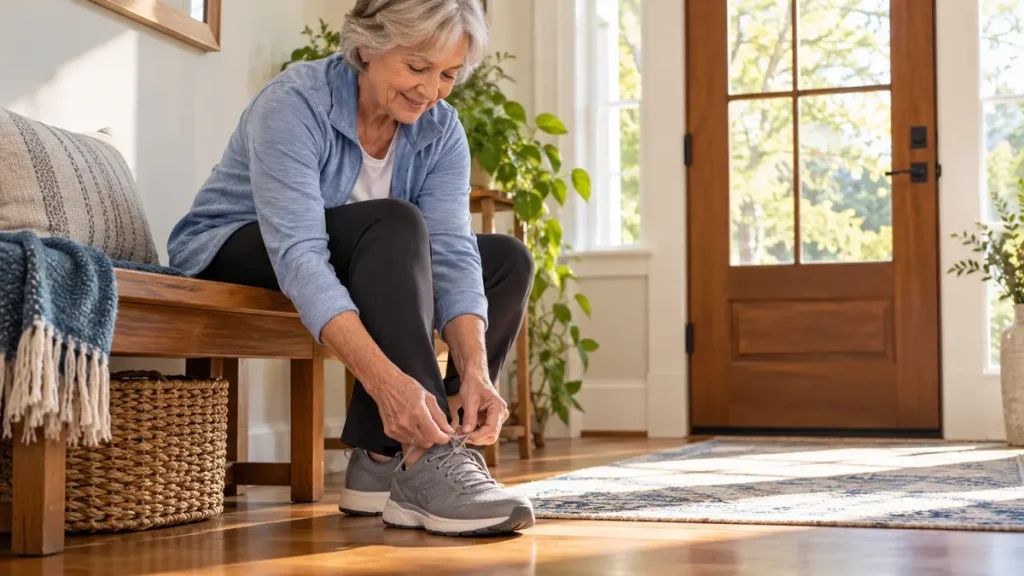
- Put a charged phone, glasses, and appropriate footwear beside the bed.
- Write down repairs and health questions that need follow-up.
Revisit the list every few months and after any change in health, medication, vision, mobility, or living arrangement. Seasonal checks are useful too: outdoor leaves, ice, wet entrances, and shorter daylight hours can change risk even when the indoor layout stays the same.
Bottom line
Home fall prevention after 60 works best as a layered plan. Clear the routes you use, improve lighting, secure footing, install proper support in bathrooms and on stairs, and keep everyday items within easy reach. Then pair those changes with medication review, vision and health care, appropriate strength and balance activity, and a way to summon help.
Begin with the hazards you can correct today, but do not treat a fall as only a housekeeping problem. A fall, near-fall, new dizziness, or changing mobility is a reason to discuss individual risks with a qualified health professional. General guidance can organize the questions; it cannot replace an assessment tailored to the person and the home.