
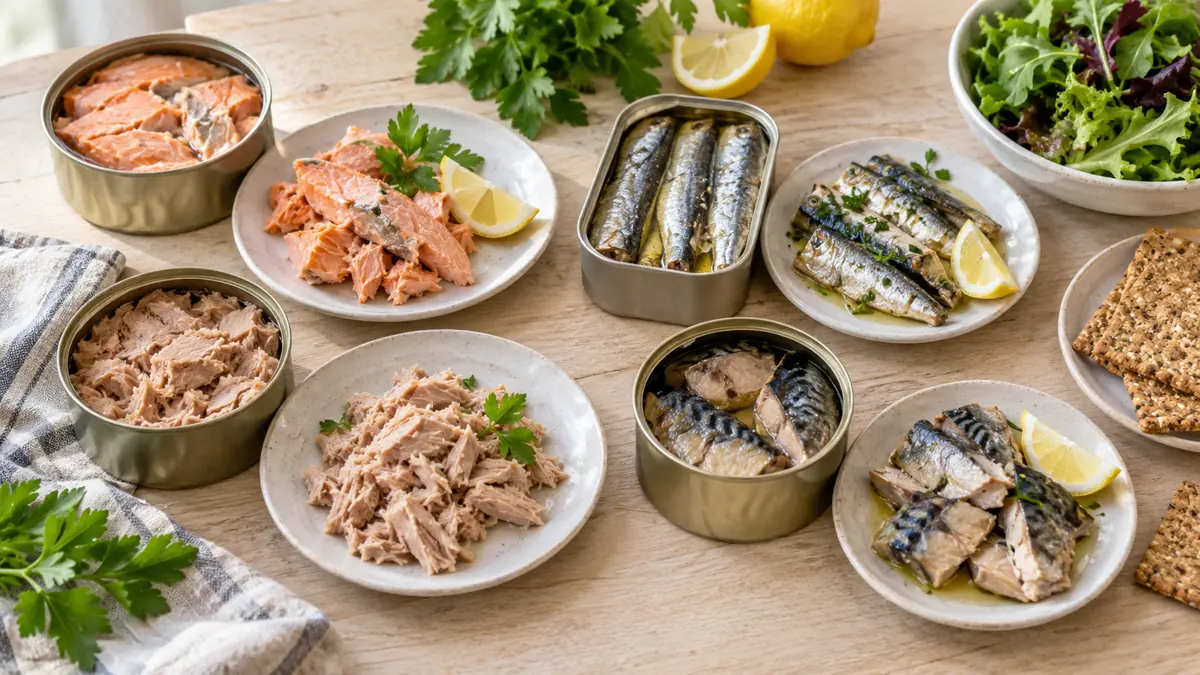
Canned fish can be one of the fastest ways to add protein and seafood to a meal, but the shelf can be confusing. A can of salmon, sardines, mackerel, or tuna may look interchangeable until you compare mercury guidance, sodium, edible bones, serving size, and packing liquid. This guide explains how to read those differences without treating any one fish as a miracle food. It also offers practical ways to choose, prepare, and store canned fish safely.
Practical note: the nutrition facts can vary substantially by species, brand, serving size, packing liquid, and added seasonings. Use the package in your hand as the final source for sodium, calories, and other listed nutrients.
Why canned fish deserves a closer look
Canning makes seafood shelf-stable, portable, and ready to eat. It can reduce the planning barrier that often keeps seafood out of weekday meals. Fish provides protein and a range of nutrients; the U.S. Food and Drug Administration notes that seafood can supply omega-3 fats, iron, iodine, choline, vitamin B12, vitamin D, selenium, and zinc. The exact profile depends on the fish.
Convenience does not make every can nutritionally identical. Some products include soft bones, which can add calcium. Some oily fish provide more long-chain omega-3 fats than leaner fish. Sodium can range from modest to substantial, especially when fish is packed in brine or sauce. Mercury considerations also differ by species, and the word “tuna” alone does not tell the whole story.
The useful question is not “Which canned fish is healthiest?” but “Which can best fits this meal, this person, and the rest of the week?”
Start with the species, not the front-of-package claims
The species name gives more actionable information than broad claims such as “natural” or “premium.” FDA and EPA advice places salmon, sardines, Atlantic mackerel, Pacific chub mackerel, and canned light tuna among “Best Choices” based on mercury levels. Albacore, or white tuna, is a “Good Choice” and generally contains more mercury than canned light tuna. King mackerel is a different fish from Atlantic or Pacific chub mackerel and belongs in the highest-mercury group that certain people should avoid.
| Common canned option | Useful feature | Label or safety detail to check |
|---|---|---|
| Salmon with soft bones | Protein, omega-3 fats, and calcium from edible bones | Whether skin and bones are included; sodium per serving |
| Sardines | Small fish with omega-3 fats; edible bones can provide calcium | Oil, water, brine, or sauce; sodium and serving size |
| Atlantic or Pacific chub mackerel | Oily fish that can add variety | Do not confuse with king mackerel; check added salt |
| Canned light tuna | Mild, versatile protein; FDA “Best Choice” | “Light” rather than albacore; sodium and oil or water pack |
| Albacore or white tuna | Firm texture and mild flavor | FDA “Good Choice”; follow frequency guidance for higher-mercury fish |
This table is a shopping orientation, not a prescription. Availability, allergies, dietary pattern, pregnancy, age, and medical conditions can change what is appropriate.
Use the Nutrition Facts label to compare sodium fairly
Sodium is one of the biggest differences between similar canned fish products. Compare the same serving size whenever possible. A can may contain more than one labeled serving, so eating the whole container can multiply the sodium shown per serving. The FDA’s Daily Value for sodium is 2,300 milligrams; 5% Daily Value or less per serving is considered low, while 20% or more is considered high.
A four-step label check
- Confirm the serving size and the number of servings in the container.
- Compare sodium in milligrams and percent Daily Value across similar fish.
- Look at the ingredient list for salt, broth, brine, sauces, or salty seasonings.
- Consider the entire meal: crackers, bread, cheese, olives, pickles, and condiments can add more sodium.
Terms such as “no salt added,” “low sodium,” and “reduced sodium” are not interchangeable. “Reduced sodium” means less than a reference product, not necessarily a low-sodium food. The most reliable comparison remains the sodium line on the Nutrition Facts panel. The American Heart Association also recommends comparing brands and choosing no-added-salt or lower-salt canned fish when available.
| Label signal | What it helps answer | Common comparison mistake |
|---|---|---|
| Serving size | How much the listed numbers describe | Comparing one full can with one-third of another can |
| Sodium, mg | The actual sodium amount per serving | Looking only at a front-label claim |
| Sodium, %DV | Whether a serving is relatively low or high | Forgetting that multiple servings add together |
| Ingredient list | Whether salt, broth, or sauce was added | Assuming water-packed always means low sodium |
If your clinician has given you a specific sodium target for high blood pressure, heart failure, kidney disease, or another condition, that individualized target takes priority over general label guidance.
Understand mercury without giving up seafood
Mercury risk is managed by choosing species wisely and varying seafood, not by assuming all canned fish is unsafe. FDA and EPA guidance is especially important for people who are pregnant, might become pregnant, or are breastfeeding, and for children. Older adults and people with underlying health conditions may also benefit from emphasizing lower-mercury “Best Choices,” according to EPA.
Light tuna and albacore are not the same choice
Canned light tuna usually contains smaller tuna species, most often skipjack. Albacore, or white tuna, is a larger, longer-lived fish. FDA states that albacore typically contains about three times more mercury than canned light tuna. The agency therefore places canned light tuna in “Best Choices” and albacore in “Good Choices.” This distinction is more useful than comparing oil-packed with water-packed tuna, because packing liquid does not change the species.
Safety note: people in pregnancy-related groups and caregivers choosing fish for children should follow the current FDA/EPA chart for species, portions, and frequency. Advice may also differ for locally caught fish, which can be subject to state, Tribal, or local advisories.
| Situation | Useful action | Why it matters |
|---|---|---|
| Buying tuna often | Distinguish canned light from albacore or white tuna | They fall into different mercury-choice categories |
| Choosing mackerel | Check the exact species | Atlantic and Pacific chub differ from king mackerel in FDA guidance |
| Pregnant, breastfeeding, or feeding a child | Use the FDA/EPA serving and species chart | Developing nervous systems are more sensitive to methylmercury |
| Eating self-caught fish | Check the relevant local fish advisory | Contaminants vary by water body and species |
Edible bones can change the calcium picture
Canned salmon and sardines are often processed with soft bones that are intended to be eaten. The National Institutes of Health Office of Dietary Supplements identifies canned sardines and salmon with bones as food sources of calcium. If you remove the bones, you remove much of that particular advantage.
The bones usually mash easily into salmon patties, grain bowls, spreads, or salads. For someone new to the texture, start by crushing them thoroughly with a fork. Check the label because boneless products are also sold, and the amount of calcium can differ.
Food-based calcium can contribute to an overall dietary pattern, but canned fish does not replace evaluation for osteoporosis, vitamin D deficiency, swallowing problems, or other medical concerns. People with kidney disease or those following mineral restrictions should ask their clinician or registered dietitian how canned fish fits their plan.
Oil-packed, water-packed, and sauce-packed fish
Packing liquid affects flavor, texture, calories, and how a fish works in a recipe. It does not automatically determine quality. Water-packed fish can be useful when you want a neutral base. Oil-packed fish may be richer and can make a satisfying salad or toast with fewer added ingredients. Tomato, mustard, chili, or other sauces can add flavor but may also add sodium or sugar.
Choose by the meal you are building
- For a creamy salad, water-packed tuna or salmon lets yogurt, avocado, or dressing control the texture.
- For pasta, beans, or greens, oil-packed sardines or mackerel can provide both fish and flavorful oil; count the oil if calories matter to you.
- For a quick snack, flavored fish may be convenient, but compare sodium and added sugars between sauces.
- For calcium, prioritize salmon or sardines labeled with edible bones rather than relying on the packing liquid.
Draining changes what ends up on the plate, but the label may state whether nutrition values apply to drained solids or the entire contents. Read that wording before making exact calculations.
A practical canned-fish shopping routine
A repeatable routine keeps comparison simple even when brands change. First, choose a species that fits current mercury guidance. Second, compare equivalent serving sizes and sodium. Third, decide whether bones, skin, oil, or sauce support the meal you plan to make. Finally, inspect the container.
Avoid cans that are swollen, leaking, punctured, deeply rusted, or severely dented, especially around seams. FDA food-storage guidance advises discarding or returning damaged cans because damage can compromise safety. Do not taste food from a suspicious container to test it.
Turn one can into a balanced meal
Canned fish is a component, not a complete diet. Pairing it with plant foods can add fiber, color, texture, and energy. These combinations are templates rather than fixed recipes:
- Salmon with white beans, chopped celery, lemon, herbs, and whole-grain toast.
- Sardines over tomatoes and greens with a baked potato or whole-grain crackers.
- Light tuna with chickpeas, cucumber, parsley, olive oil, and vinegar.
- Mackerel folded into brown rice with shredded cabbage and a citrus dressing.
When the fish is salty, build the rest of the meal from lower-sodium ingredients and use acid, herbs, pepper, garlic, or spices for flavor. Rinsing can remove some surface salt, and the American Heart Association specifically suggests rinsing lower-salt canned fish before cooking, but it does not turn every product into a low-sodium food.
Store opened canned fish safely
Once a can is opened, the fish is no longer shelf-stable. Transfer leftovers to a covered food-safe container, refrigerate promptly, and follow the product directions. FDA guidance says perishable seafood should not remain at room temperature for more than two hours, or more than one hour when the temperature is above 90°F (32°C). Keep the refrigerator at or below 40°F (4°C).
Discard fish with a suspicious appearance or odor, but remember that harmful bacteria do not always change smell or appearance. People who are pregnant, older, very young, or immunocompromised have a higher risk of severe foodborne illness and should be especially careful with temperature control and storage.
When general guidance is not enough
Ask a qualified health professional for individual advice if you have a fish allergy, kidney disease, heart failure, difficulty swallowing, a prescribed sodium or protein restriction, or concerns about pregnancy and mercury exposure. A registered dietitian can help compare products within a therapeutic diet. Seek prompt medical care for symptoms of a serious allergic reaction or severe foodborne illness rather than trying to solve them through food substitutions.
This article provides general nutrition and food-safety information. It does not diagnose a condition, set an individual intake target, or replace care from a clinician who knows your medical history.
Bottom line
Canned fish can be an affordable, practical protein that also contributes valuable nutrients. Choose by species first, then compare serving size, sodium, ingredients, and whether soft bones are included. Canned light tuna, salmon, sardines, and certain mackerel species can help keep mercury exposure lower, while albacore calls for closer attention to frequency guidance. The best can is the one that fits current safety advice, the rest of your meal, and any personal nutrition plan from your care team.
Sources
- U.S. Food and Drug Administration: Advice about Eating Fish
- FDA: Questions and Answers on FDA/EPA Fish Advice
- U.S. Environmental Protection Agency: Fish and Shellfish Concerns
- FDA: Daily Value on Nutrition and Supplement Facts Labels
- NIH Office of Dietary Supplements: Calcium Fact Sheet for Consumers
- American Heart Association: Choosing and Preparing Fish
- FDA: Are You Storing Food Safely?


