A date stamped on a carton, jar, or package can look like a clear stop sign. In the United States, however, most food date labels are not a universal safety deadline. They are often the manufacturer’s estimate of peak quality, while safe handling, refrigerator temperature, time since opening, recalls, and the type of food may matter more.
This guide explains how to read common food date labels without either wasting food automatically or taking unnecessary risks. It focuses on practical decisions for packaged foods, refrigerated items, leftovers, infant formula, and recalled products. It offers general food-safety information, not individualized medical advice.
Why food date labels cause so much confusion
Packages use phrases such as “Best By,” “Best if Used By,” “Sell By,” “Use By,” and “Expires On.” Those phrases sound standardized, but the U.S. Food and Drug Administration’s food waste and safety guidance says there are no uniform, universally accepted descriptions for open dating across U.S. packaged foods. Except for infant formula, federal law generally does not require manufacturers to place quality-based dates on packaged food.
Manufacturers may select a date to indicate when flavor, texture, color, or another quality is expected to be best. That does not mean every product becomes unsafe at midnight after the printed day. At the same time, a date should never override evidence that food was mishandled, recalled, contaminated, or held too long at an unsafe temperature.
A package date is one piece of evidence. A safer decision also considers the food, how it was stored, whether it was opened, who will eat it, and whether a recall applies.
| Label phrase | What it commonly communicates | Useful response |
|---|---|---|
| Best By / Best if Used By | Expected peak quality | Check storage history and condition rather than discarding solely because the date passed |
| Sell By | Inventory guidance for a retailer | Do not treat it as a home safety timer; use food-specific storage guidance |
| Use By / Expires On | Meaning can vary by product and jurisdiction | Follow product instructions; apply special rules for infant formula and other regulated or medically important products |
| Freeze By | A suggested point for freezing while quality remains good | Freeze earlier if you will not use the food within its recommended refrigerator time |
Separate quality from safety
Quality changes are often visible or sensory: crackers lose crispness, spices lose aroma, or frozen food develops dry patches. Safety hazards can be less obvious. Disease-causing germs may not change a food’s smell, appearance, or taste. For that reason, “it smells fine” is not a complete safety test for perishable food that was left warm too long, stored beyond recommended refrigerator limits, or included in a recall.
The FDA supports “Best if Used By” as a phrase for the date when a food is expected to have its best flavor and quality. The agency advises examining foods past that date for noticeable changes in color, consistency, or texture. That guidance applies only after considering storage and other safety factors.
Safety note: Never taste food to test whether questionable storage made it unsafe. When time or temperature history is unreliable, disposal is safer than a sensory experiment.
Quality clues that call for judgment
- Staling, loss of crispness, or muted flavor in a shelf-stable food
- Freezer burn or ice crystals that reduce texture quality
- Separation that the label says is normal and can be mixed
- Minor cosmetic changes in intact produce without mold or decay
Safety clues that outweigh the printed date
- A bulging, leaking, badly rusted, or deeply dented can
- Broken seals, damaged packaging, or food that spurts unexpectedly when opened
- Visible mold on foods where trimming is not specifically considered safe
- A perishable item left unrefrigerated beyond recommended limits
- A matching product, lot code, or package size named in a recall notice
Use storage time, temperature, and opening date together
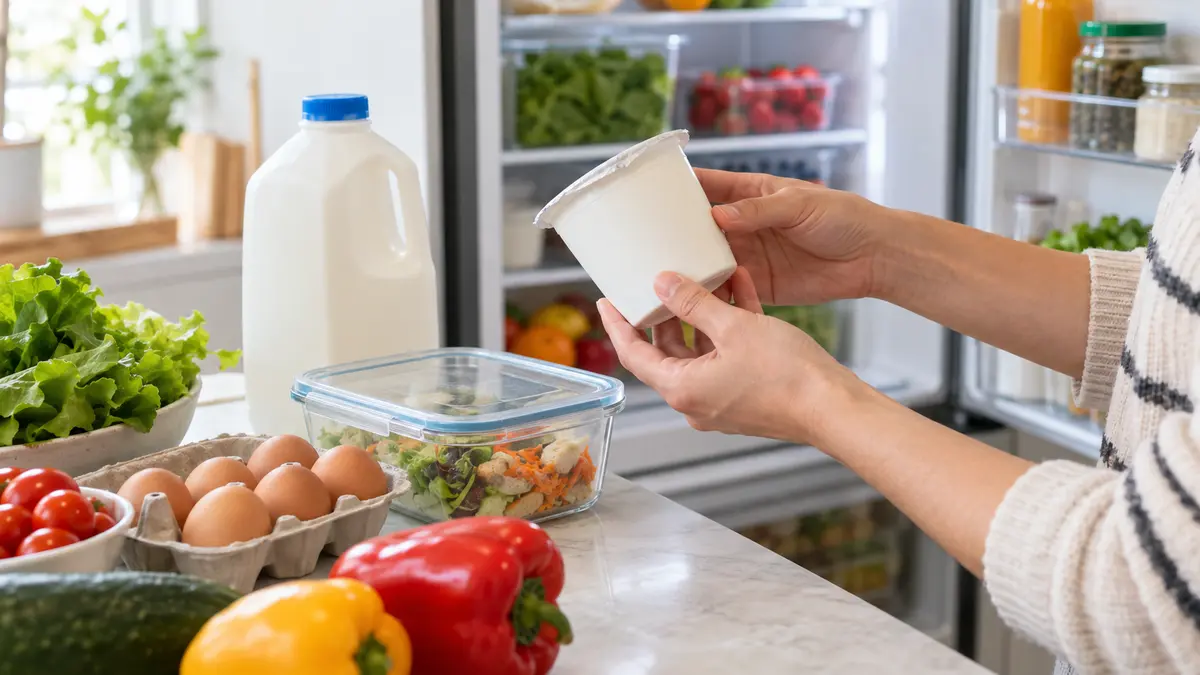
Once a product is opened, the printed package date often becomes less useful than the opening date and food-specific storage guidance. A jar may have months remaining on its printed date, but its instructions may say to refrigerate after opening and use within a shorter period. Likewise, cooked leftovers need their own clock, starting when they were prepared.
The FoodSafety.gov cold storage chart uses a refrigerator temperature of 40°F (4°C) or below and gives food-specific limits. It lists cooked leftovers and many prepared salads at three to four days, while raw ground meats and poultry generally have shorter refrigerator windows. Freezer times on the chart are mainly about quality when food stays continuously frozen at 0°F (-18°C) or below.
The U.S. Environmental Protection Agency’s home food-waste guidance also recommends keeping the refrigerator at 40°F or below, labeling stored foods with dates, and freezing food that will not be eaten in time.
| Question | Why it matters | Action |
|---|---|---|
| Was it kept at 40°F (4°C) or below? | Cold storage slows the growth of many harmful microbes | Use a refrigerator thermometer; do not rely only on the dial setting |
| When was it opened or cooked? | The printed date may describe an unopened product | Write the opening or cooking date on the container |
| How long was it at room temperature? | Perishable food can become unsafe before visible spoilage appears | Follow the two-hour rule, shortened to one hour above 90°F (32°C) |
| Is there food-specific guidance? | Safe refrigerator time varies widely | Check an official cold-storage chart or the product’s instructions |
A five-step decision process for food past a date
Use this sequence instead of making the package date your only test:
- Identify the food and the exact label phrase. Note whether the item is shelf-stable, refrigerated, frozen, opened, or homemade.
- Check for a recall. Match the brand, product name, package size, lot code, and date range, not just a similar-looking package.
- Reconstruct storage. Consider refrigerator temperature, power outages, time in a hot car, and how long the food sat out during serving.
- Check official food-specific limits and label directions. Give priority to “refrigerate after opening,” preparation, and disposal instructions.
- Inspect without tasting. Discard food with damaged packaging, unexpected swelling, mold, off odors, or major texture and color changes. If the safety history is uncertain, do not gamble.
Practical note: A simple piece of tape marked “opened” or “cooked” with the date can prevent more confusion than trying to remember when a container first entered the refrigerator.
Know the important exceptions
Infant formula
Infant formula is the clearest federal exception. The FDA’s infant formula handling guidance says every container must carry a “Use By” date and should not be used after that date. The date reflects the period through which the manufacturer guarantees nutrient content and quality. Caregivers should also follow the package’s instructions for storage before and after opening and for disposal of prepared formula.
Recalled food
A future package date does not make a recalled product safe. The FDA’s consumer recall guidance explains that notices identify products using details such as package size, UPC, lot code, date range, images, and distribution area. Follow the recall instructions. Do not donate recalled food or give it to another person or a pet.
Foods for people at higher risk
Adults 65 and older, children younger than five, pregnant people, and people with weakened immune systems have a higher chance of serious foodborne illness. FoodSafety.gov’s guidance for higher-risk groups recommends safer food choices and careful handling. A conservative decision is appropriate when storage history is uncertain or the food is one of the higher-risk choices listed in official guidance.
| Situation | Do not rely on | Safer priority |
|---|---|---|
| Infant formula at or past its Use By date | Smell or appearance | Do not use it after the date; follow FDA and package instructions |
| Product named in a recall | A date that has not passed | Match identifiers and follow the recall notice |
| Food for a higher-risk person | A casual “probably fine” judgment | Use official safer-choice and storage guidance |
| Unknown time or temperature history | Tasting a small amount | Discard when safe storage cannot be established |
Why smell and appearance have limits
Sensory checks are useful for spotting spoilage and quality decline, but they cannot certify safety. Some harmful bacteria or toxins may be present without an obvious odor, flavor, or visible change. The opposite is also true: a harmless quality change can make a food less appealing without making it dangerous.
The Centers for Disease Control and Prevention’s food-poisoning prevention guidance emphasizes four actions: clean, separate, cook, and chill. These controls reduce risk more reliably than treating appearance as a laboratory test. The CDC also says recalled food should be thrown away.
Use your senses only after the basic safety checks have passed. For a shelf-stable food stored correctly in intact packaging, a “Best if Used By” date plus a quality inspection may be reasonable. For raw meat, prepared leftovers, cut melon, unpasteurized foods, or any product with an uncertain cold chain, time and temperature deserve more weight.
Build a low-waste, safety-first kitchen system
Reducing waste does not require stretching risky food. It works better when you prevent food from becoming questionable.
- Keep a refrigerator thermometer where it is easy to see and maintain 40°F (4°C) or below.
- Put newly purchased items behind older ones so foods are used in order.
- Label leftovers with the cooking date and opened foods with the opening date.
- Freeze realistic portions before refrigerator time runs out.
- Keep a short “use first” area or list for foods approaching their quality date.
- Review official recall notices when a product is announced, matching all identifiers.
- Buy bulk quantities only when your household can store and use them safely.
A weekly five-minute refrigerator review can catch leftovers before their safe window closes and move extra bread, produce, or cooked meals into the freezer. Clear containers help make food visible, while shallow containers help hot leftovers cool more quickly.
When symptoms or uncertainty need professional help
Foodborne illness can cause vomiting, diarrhea, abdominal pain, or fever, but symptoms and severity vary. Contact a qualified health professional for individualized advice when illness is severe, worsening, persistent, affects a higher-risk person, or raises concern about dehydration or another complication. Seek urgent care for emergency symptoms according to local medical guidance.
For a possible recalled product, follow the recall notice and report problems through the channels it names. The FDA advises people who believe an FDA-regulated product made them sick to contact a healthcare professional and report the event. Do not use a general article to diagnose the cause of symptoms or decide that medical care is unnecessary.
Bottom line
Most U.S. food date labels are not a universal countdown to danger. “Best if Used By” generally points to quality, while a “Sell By” date is mainly useful to retailers. The phrase alone is not enough to judge every product.
Start with the food’s identity, recall status, storage temperature, time since opening or cooking, and official food-specific guidance. Treat infant formula as a firm exception and use extra caution for people at higher risk of foodborne illness. When safe storage cannot be established, do not taste-test the uncertainty. A labeled, cold, well-organized refrigerator is the simplest way to waste less food without weakening safety.
Sources
- U.S. Food and Drug Administration: How to Cut Food Waste and Maintain Food Safety
- FoodSafety.gov: Cold Food Storage Chart
- U.S. Food and Drug Administration: Handling Infant Formula Safely
- Centers for Disease Control and Prevention: Preventing Food Poisoning
- U.S. Environmental Protection Agency: Preventing Wasted Food at Home
- FoodSafety.gov: People at Risk of Food Poisoning
- U.S. Food and Drug Administration: Food Recalls—What You Need to Know