A smartphone hearing test can be a useful first check when conversations seem muffled, television volume keeps creeping up, or noisy restaurants have become harder to follow. These tools can make screening more convenient, but convenience is not the same as diagnosis. Results depend on the test design, the phone, the headphones, background noise, and how carefully the test is completed.
This guide explains what smartphone hearing tests can and cannot tell you, how to get a more useful result, when to repeat a screen, and when an in-person assessment matters. It focuses on practical, evidence-based use rather than any particular app or brand.
What a smartphone hearing test actually measures
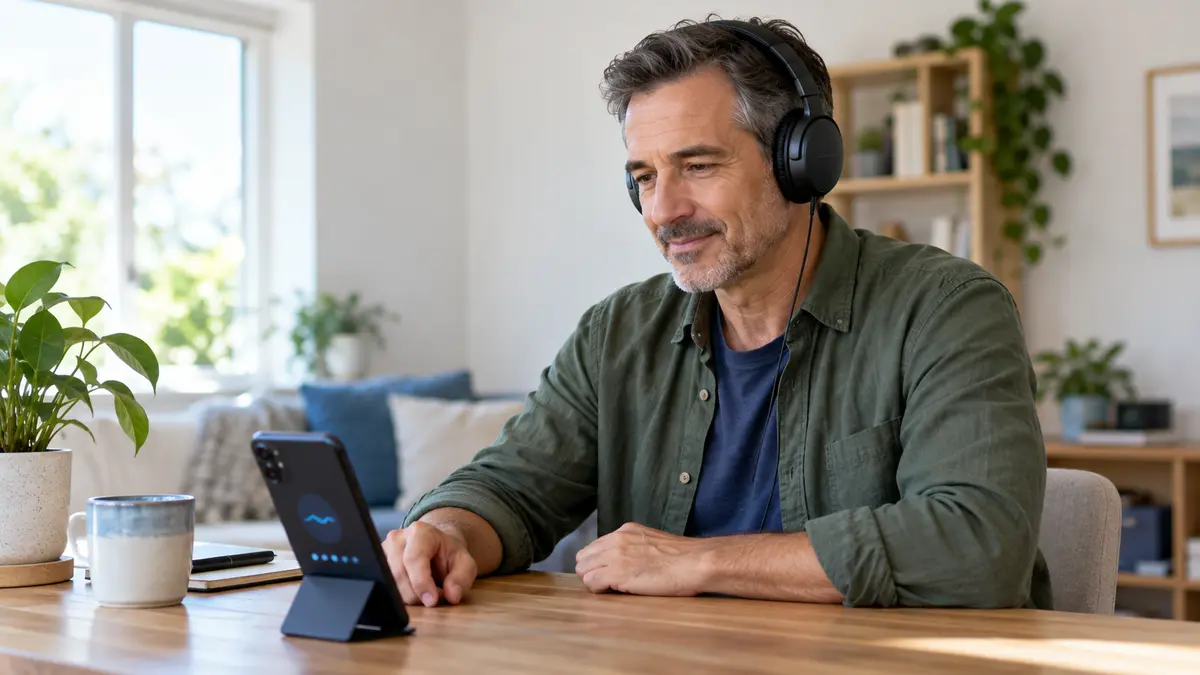
Many phone-based tests present tones or speech through headphones and ask you to respond when you hear them. A tone-based test may estimate the quietest sound you can detect at several pitches. A speech-based screen may ask you to recognize words, numbers, or speech in background noise. Some tools produce a pass-or-refer result, while others display an estimated hearing profile.
These outputs answer a limited question: whether your responses suggest possible hearing difficulty under the conditions of that test. They do not show the condition of the ear canal or eardrum, identify why hearing has changed, or replace the full set of tests used by a hearing professional.
A phone screen is best treated as a signal for the next decision, not a final label about your hearing.
| Test type | What it may explore | Important limitation |
|---|---|---|
| Pure-tone screen | Responses to beeps at different pitches and levels | Calibration and headphone differences can shift the result |
| Speech or digits-in-noise screen | Ability to recognize speech-like material with competing noise | Language, attention, and device audio processing can affect performance |
| Questionnaire | Everyday listening difficulty and its practical impact | It reflects experience, not measured hearing thresholds |
What the evidence says about accuracy
Research suggests that well-designed digital hearing tools can identify possible hearing loss with useful accuracy, but results vary across tools and testing conditions. A recent systematic review of self-administered web and app audiometry found substantial differences in study methods, devices, headphones, settings, and definitions of hearing loss. That variation makes it difficult to assume that every app performs like a clinically evaluated tool.
The evidence also reinforces a basic distinction: pure-tone audiometry administered in a controlled setting remains the reference comparison in validation studies. A consumer test may be helpful for screening, especially when access is limited, but the quality of evidence for one tool does not automatically transfer to another tool with a similar interface.
Evidence note: Look for a clear description of independent validation against conventional audiometry. App-store ratings, download counts, and polished graphics do not establish diagnostic accuracy.
Why validation must be specific
A test is not simply “validated” in the abstract. Useful evidence should identify the population studied, the phone or tablet setup, the headphones, the test environment, and the outcome used for comparison. Performance in a quiet clinic with calibrated equipment may not match performance in a kitchen with unknown earbuds.
Why a pass can still miss a problem
No screening test detects every case. A person can pass a limited frequency screen yet still struggle with speech in noise, have fluctuating symptoms, or have an ear condition that needs examination. The opposite is also possible: background noise, poor headphone fit, or misunderstanding the task can produce a refer result even when a later clinical assessment is reassuring.
Set up the test for a more useful result
Preparation reduces avoidable errors. The World Health Organization’s guidance for its hearing-screening application emphasizes a quiet environment, functioning equipment, correct headphone placement, clear instructions, and referral for a full assessment after a repeated refer result. Those principles are sensible for consumer screening more broadly, even though different tools use different protocols.
- Choose the quietest available room. Turn off television, music, fans, and nearby appliances. Close windows if traffic or construction noise is audible.
- Use the equipment specified by the test. Do not switch headphones midway through. If the tool names compatible hardware, follow that requirement.
- Check left and right placement. Seat over-ear cups fully and remove anything that prevents a good fit. Set up wired or wireless connections before beginning.
- Read the instructions before the tones start. Confirm how to respond and whether the app controls volume automatically.
- Test when alert. Fatigue, distraction, and guessing can make responses less consistent.
- Save the context with the result. Record the date, device, headphones, room conditions, symptoms, and whether one ear differed from the other.
| Setup factor | Better choice | Why it matters |
|---|---|---|
| Room | Quiet, closed room away from traffic | Ambient sound can mask soft test signals |
| Headphones | Correctly fitted pair used for the whole test | Fit and output vary between headphones |
| Attention | Short, uninterrupted session | Missed cues can look like poorer hearing |
| Timing | When symptoms are stable and you feel well | Temporary congestion or fatigue may complicate interpretation |
How to interpret pass, refer, and threshold results
A pass generally means the test did not identify difficulty at its chosen screening levels. It is reassuring only within that tool’s scope. If daily communication remains difficult, arrange a professional hearing evaluation even after a pass.
A refer or fail result means the screen detected a pattern that deserves another look. It does not confirm hearing loss or reveal its cause. First review the instructions, equipment, and room, then repeat the screen once under better conditions if the tool permits. If the result remains concerning, take the record to a qualified professional.
An estimated threshold chart can look clinical, but precision on a screen does not guarantee clinical precision. Focus on the overall pattern, differences between ears, repeatability, and how the result fits real-world symptoms. Avoid making treatment or purchasing decisions from a single self-test alone.
A practical result log
- Date and approximate time of the test
- Phone or tablet model and operating system
- Headphone type and whether it fit securely
- Room and possible noise sources
- Result for each ear and whether it repeated
- Recent symptoms, noise exposure, illness, or medication changes
When not to rely on an app
Safety note: Sudden hearing loss in one or both ears is not a wait-and-retest situation. The National Institute on Deafness and Other Communication Disorders describes sudden sensorineural hearing loss as a medical emergency and advises immediate medical attention. A phone test must not delay that evaluation.
Prompt professional care is also appropriate for ear pain, drainage or blood, severe dizziness, a foreign object, significant head injury, rapidly worsening hearing, or a marked difference between ears. Children need age-appropriate assessment, and a consumer adult screen should not be used to make conclusions about a child’s hearing.
| Situation | Appropriate next step | Role of a phone test |
|---|---|---|
| Sudden or rapidly worsening hearing | Seek urgent medical evaluation | Do not use it to delay care |
| Ear pain, drainage, blood, or severe dizziness | Contact a clinician promptly | Cannot examine the ear or find the cause |
| Repeated refer result without urgent symptoms | Book a full hearing assessment | Bring the result as background information |
| Pass result but persistent communication difficulty | Discuss symptoms with a hearing professional | A limited screen may not capture the problem |
| Occasional check without symptoms | Keep a dated record and monitor changes | Useful as a consistent baseline only if setup is repeatable |
Privacy and accessibility deserve attention
A hearing test may collect health-related responses, age information, device identifiers, microphone permissions, or account details. Before using a tool, review what data it collects, whether an account is required, how results can be deleted, and whether data may be shared for advertising or analytics. Grant only permissions needed for the stated function.
Usability matters too. Small controls, unclear instructions, advertisements, or poor compatibility with screen readers can interfere with the task. A tool that cannot be operated confidently is unlikely to produce a dependable self-administered result. Ask another person to help with setup if needed, but protect the privacy of the result.
From screening to professional assessment
A primary care professional can look for common contributors such as earwax, infection, injury, or medication-related concerns and refer onward when needed. An audiologist has specialized training to measure hearing and identify the type and degree of hearing loss. An ear, nose, and throat physician evaluates medical and surgical conditions affecting the ear.
A clinical visit may include visual examination of the ear, calibrated pure-tone testing, speech testing, and other measures selected for the person’s symptoms. This broader assessment is why an app result cannot stand alone as a diagnosis.
Questions to bring to an appointment
- Did the change happen gradually or suddenly?
- Is one ear different from the other?
- Are ringing, dizziness, pressure, pain, or drainage present?
- Which listening situations are hardest?
- Was there recent loud-noise exposure?
- Could any health condition or medication be relevant?
Do phone results determine whether you need hearing aids?
No. A screening result can support a decision to seek evaluation, but it should not be treated as a prescription. In the United States, over-the-counter hearing aids are intended for adults age 18 and older with perceived mild to moderate hearing loss. The Food and Drug Administration notes that some self-fitting products may use hearing tests, software, or smartphone apps, but the devices still have defined intended users and warnings.
If hearing difficulty seems severe, affects only one ear, changes quickly, or comes with other ear symptoms, professional assessment is the safer next step. Even when an over-the-counter option is appropriate, comfort, benefit, return policies, instructions, and follow-up support matter.
A sensible testing routine
There is no universal consumer schedule that fits everyone. Testing is more useful when it responds to a real reason: a new communication difficulty, repeated noise exposure, concern raised by family, or follow-up after a previous screen. The Centers for Disease Control and Prevention advises people with signs of, or risk for, noise-induced hearing loss to have their hearing tested.
If you repeat a phone screen over time, use the same tool, device, headphones, room, and procedure when possible. Consistency makes changes easier to interpret. A new pattern should be considered alongside symptoms, not as an isolated number.
Bottom line
Smartphone hearing tests can lower the barrier to an initial screen and may provide useful information when they are well designed and used carefully. Their strongest role is to prompt attention, document a concern, and guide the next step. They cannot inspect the ear, diagnose the cause of a change, or guarantee that hearing is normal.
Use a quiet room, follow equipment instructions, repeat an unclear refer result once, and seek a full assessment when concerns persist. Treat sudden hearing loss or rapidly worsening symptoms as urgent. General information cannot replace individualized evaluation by a qualified health professional.
Sources
- Systematic review of self-administered web- and app-based audiometric tools
- World Health Organization: WHOears hearing-screening app FAQs
- NIDCD: Sudden sensorineural hearing loss
- CDC: Signs of noise-induced hearing loss
- NIDCD: Hearing health professionals and their roles
- FDA: What to know about over-the-counter hearing aids