Slow breathing is one of the simplest mind-body practices: it asks for no equipment, no special outfit, and only a few minutes of attention. That simplicity is part of its appeal. When stress feels scattered, a slower rhythm can give the body a clear, repeatable cue: pause, soften the shoulders, and let the next exhale be a little longer than the last.
The evidence is encouraging, but it is not a magic wand. Public health sources describe breathing exercises as one type of relaxation technique that may help people manage stress, and newer studies continue to explore how structured breathing affects mood, perceived stress, sleep quality, and anxiety. The best use is practical and modest: slow breathing for stress can be a daily support, not a replacement for medical or mental health care when symptoms are severe or persistent.
Think of slow breathing as a small reset button, not a cure-all. It works best when it is practiced regularly and paired with the basics: sleep, movement, supportive relationships, and professional care when needed.
What Slow Breathing Is Supposed To Do
Most slow-breathing practices ask you to notice the breath, reduce the pace, and breathe in a way that feels steady rather than forced. Some techniques emphasize belly movement, some lengthen the exhale, and some simply ask you to keep returning attention to the sensation of breathing. In everyday language, the goal is to help the nervous system shift out of hurry mode.
Relaxation techniques are often discussed as ways to encourage a relaxation response. That does not mean every person will feel calm immediately. It means the practice gives the body repeated conditions that can support lower tension, quieter attention, and a sense of control. For some people, the first benefit is not dramatic calm; it is noticing, sooner than usual, that stress has begun to climb.
That noticing matters. A breathing practice can create a bridge between a stress signal and a better choice. Instead of answering an email in a rush, staying frozen in worry, or carrying tension into bed, you have a brief routine that can be repeated anywhere.
What The Evidence Supports So Far
Several reliable health organizations include breathing exercises within broader relaxation and stress-management guidance. MedlinePlus describes deep breathing as one practical relaxation method, while the National Center for Complementary and Integrative Health notes that relaxation techniques can include breathing exercises, progressive relaxation, guided imagery, and self-hypnosis. These sources also stress an important boundary: relaxation practices may help with stress, but they should not delay care for health problems.
Research on breathing continues to evolve. A 2025 Scientific Reports study of mindfulness breathing meditation in young adults found improvements in perceived stress and cognitive flexibility after a four-week program, while also noting that some measures, including heart-rate variability and attention outcomes, did not change. A 2025 Frontiers study reported that slow-paced breathing was associated with lower anxiety in a university sample, but the authors described the work as initial evidence and called for larger, more diverse research. A 2025 BMC Public Health study of a structured breathing program in physical therapy students reported improvements in subjective happiness, positive affect, sleep quality, and worry, while also noting the limits of a non-randomized, self-selected design.
In other words, the signal is promising, especially for stress-related self-regulation, but the details still matter: who is practicing, how often, which method is used, and what outcome is being measured.
| Evidence area | What it suggests | How to interpret it |
|---|---|---|
| Public health guidance | Breathing exercises are recognized as relaxation tools. | Useful for stress support, not a substitute for diagnosis or treatment. |
| Perceived stress | Some breathing and mindfulness-breathing programs reduce self-reported stress. | Self-report is meaningful, but it can vary by person and setting. |
| Anxiety | Slow-paced breathing may reduce anxiety in some short-term contexts. | Evidence is still developing, especially outside small student samples. |
| Sleep quality | Structured programs may improve reported sleep quality for some participants. | Sleep problems with medical causes need fuller evaluation. |
What Slow Breathing Is Not
A breathing practice should not be sold as a guaranteed treatment for anxiety disorders, insomnia, high blood pressure, trauma symptoms, panic attacks, or depression. It may support people with some of these concerns, but the evidence is mixed by condition, and individual responses differ. If a symptom is intense, new, worsening, or interfering with daily life, the right next step is professional support.
It is also not a test of discipline. If counting breaths makes you more tense, if breath holding feels uncomfortable, or if closing your eyes increases unease, the practice can be changed. A useful relaxation method should help you feel safer and more present, not trapped inside a rigid script.
Choose A Technique That Matches The Moment
The best breathing technique is the one you will actually use. A two-minute routine before a meeting may be more valuable than a perfect twenty-minute session you never begin. Start with a low-friction version, then adjust the pace and setting as you learn what your body tolerates well.
| Technique | Best fit | Caution |
|---|---|---|
| Diaphragmatic breathing | Building awareness of belly and rib movement. | Avoid forcing the abdomen outward; keep it comfortable. |
| Longer exhale breathing | Settling after a stressful moment or before sleep. | Skip long holds if they make you dizzy or tense. |
| Mindful breathing | Training attention when thoughts are busy. | Use eyes-open practice if closing the eyes feels unsafe. |
| Brief reset breathing | Workday transitions, car pauses, or pre-conversation grounding. | Do not practice while driving if it distracts you. |
How To Practice Without Overdoing It
Begin with a short session, especially if breathwork is new to you. Sit or stand in a stable position. Relax the jaw and shoulders. Let your breath become a little slower, then notice whether your body accepts that pace. If you feel lightheaded, tight in the chest, or unusually distressed, return to normal breathing and stop the exercise.
For many people, a helpful starting dose is two to five minutes. Regular practice often matters more than intensity. The National Center for Complementary and Integrative Health notes that relaxation techniques are generally safe for healthy people, but some people report negative experiences, including increased anxiety. That is a useful reminder to keep the practice flexible and body-led.
Diaphragmatic Breathing
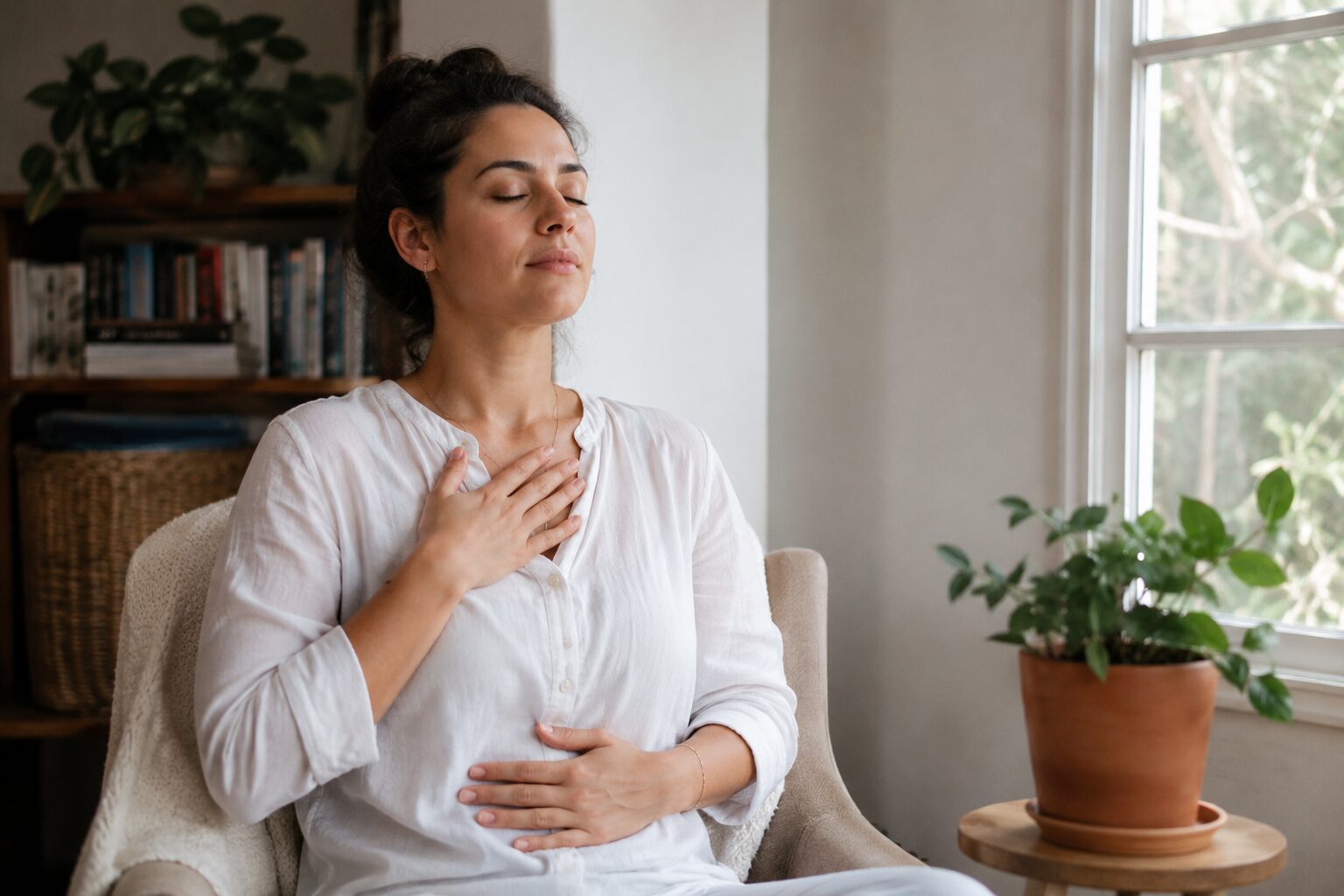
Place one hand on the upper chest and one on the abdomen. Breathe in gently through the nose if that feels comfortable, and notice whether the lower hand moves. Exhale without pushing. The point is not to perform a perfect belly breath; it is to reduce upper-body tension and let the breath feel less rushed.
Longer Exhale Breathing
Try inhaling for a comfortable count of three or four, then exhaling for a count that is slightly longer. You might use three in and five out, or four in and six out. Keep the numbers easy. If counting becomes stressful, drop the count and simply think, soft inhale, slower exhale.
Mindful Breathing
Mindful breathing is less about controlling the breath and more about returning attention. Notice the inhale, notice the exhale, and when the mind wanders, begin again. The VA’s Whole Health guidance presents mindful breathing as something that can be practiced formally or informally, which makes it useful for ordinary moments: waiting for a call, standing in a line, or settling into bed.
Safety: Who Should Use Extra Caution
Most gentle breathing exercises are low risk, but low risk does not mean risk-free. People with respiratory conditions, cardiovascular concerns, a history of panic attacks, trauma-related symptoms, or fainting episodes may want to ask a clinician which practices are appropriate. Anyone who experiences chest pain, severe shortness of breath, fainting, or sudden neurological symptoms should seek urgent medical help rather than trying to breathe through it.
Be especially careful with intense breathwork that involves rapid breathing, long breath holds, or deliberate hyperventilation. This article is about gentle slow breathing for stress support, not advanced practices. The gentler approach is usually the better starting point for daily life.
How It Fits With Sleep, Exercise, And Social Support
Breathing works best as part of a larger pattern. If you are chronically under-slept, isolated, sedentary, or overwhelmed by problems that need practical help, slow breathing may make the next ten minutes easier but will not fix the whole load. It can, however, help you do the next helpful thing.
Before sleep, a slower exhale can serve as a transition ritual. After exercise, it can help you cool down and notice how your body feels. Before a difficult conversation, it can create enough space to choose your first sentence more carefully. These small uses are not trivial. Nervous systems learn through repetition.
| Situation | Useful breathing choice | When to add support |
|---|---|---|
| Before bed | Longer exhale breathing for two to five minutes. | If insomnia lasts weeks or affects functioning. |
| Work stress | Brief reset breathing between tasks. | If anxiety or burnout is persistent. |
| After conflict | Mindful breathing with eyes open and feet grounded. | If conflict involves safety concerns or coercion. |
| General tension | Diaphragmatic breathing while seated comfortably. | If tension is painful, worsening, or unexplained. |
A One-Week Starter Plan
Use the first week as an experiment, not a challenge. The goal is to learn which version feels useful, what time of day is realistic, and whether your body responds better to counting, hand placement, or simple noticing.
| Day | Practice | Checkpoint |
|---|---|---|
| 1 | Two minutes of natural breath awareness. | Did noticing the breath feel neutral, calming, or irritating? |
| 2 | Two minutes with one hand on chest, one on abdomen. | Could you soften the shoulders without forcing the breath? |
| 3 | Three minutes of a slightly longer exhale. | Did the count feel easy enough to repeat? |
| 4 | One brief reset before a routine task. | Was it easier to start the task calmly? |
| 5 | Five minutes before bed or during an evening wind-down. | Did it help create a clearer transition? |
| 6 | Eyes-open mindful breathing in a quiet place. | Did eyes-open practice feel more grounded? |
| 7 | Choose the method you liked best and repeat it. | What would make this easy enough to keep? |
How To Track Whether It Helps
You do not need an app or wearable to decide whether a breathing practice is worth keeping. After each practice, rate your stress from zero to ten. Note the situation, the length of practice, and any side effects. After a week, look for patterns. Maybe bedtime practice helps, but workday counting does not. Maybe mindful breathing is helpful only with eyes open. Maybe the most useful change is that you pause before reacting.
Good tracking keeps expectations honest. If your stress rating drops from seven to five, that is useful. If nothing changes after two weeks, try a different relaxation method, such as progressive muscle relaxation, guided imagery, walking, or a conversation with a professional. The goal is not to become a perfect breather. The goal is to build a reliable way to come back to yourself.
Bottom Line
Slow breathing is a practical mind-body tool with a growing, but still nuanced, evidence base. It may help some people reduce perceived stress, settle anxiety in the moment, and create a calmer transition into sleep or focused work. The safest approach is gentle, flexible, and brief enough to repeat.
Start small: two minutes, one calm place, one method. Let the body decide whether the practice is helping. If symptoms are severe, persistent, or medically concerning, use breathing as a support while you seek appropriate care.
Sources
- National Center for Complementary and Integrative Health: Relaxation Techniques: What You Need To Know
- National Center for Complementary and Integrative Health: 5 Things To Know About Relaxation Techniques for Stress
- MedlinePlus: Relaxation techniques for stress
- U.S. Department of Veterans Affairs: Mindful Breathing
- Scientific Reports: Effects of mindfulness breathing meditation on stress and cognitive functions
- Frontiers in Human Neuroscience: Slow-paced breathing and anxiety
- BMC Public Health: A structured breathing program and well-being outcomes
- Frontiers in Physiology: Deep breathing exercise at work