Home blood pressure monitors have become a practical bridge between clinic visits and everyday health decisions. They can help people notice patterns, prepare better questions for appointments, and avoid relying on a single rushed office reading. But the device is only as useful as the reading is accurate. A monitor that has not been validated, a cuff that does not fit, or a rushed measurement after coffee and conversation can turn a helpful tool into noisy data.
This guide explains how to choose and use a home blood pressure monitor with fewer avoidable errors. It is general health information, not a diagnosis or treatment plan. People who already have high blood pressure, heart disease, kidney disease, diabetes, pregnancy-related concerns, fainting, chest pain, severe headache, neurological symptoms, or very high readings should involve a qualified clinician rather than trying to interpret numbers alone.
Why Home Blood Pressure Monitoring Can Help
Blood pressure changes throughout the day. Stress, pain, sleep, alcohol, caffeine, exercise, posture, and medication timing can all influence a reading. That is why a single number rarely tells the whole story. Home monitoring can add context when a clinician is screening for high blood pressure, following a treatment plan, or checking whether office readings differ from readings in daily life.
The U.S. Preventive Services Task Force hypertension screening recommendation says adults should be screened with office blood pressure measurement and that measurements outside the clinical setting should be used to confirm a hypertension diagnosis before treatment starts. Home readings are one option, while ambulatory monitoring is another. That does not mean home devices diagnose disease by themselves; it means they can provide useful evidence when used correctly and reviewed in context.
Home monitoring is best understood as a measurement system: the device, cuff, body position, timing, log, and clinician review all matter.
What “Validated” Means for a Monitor
A home blood pressure monitor may look professional without having independent evidence that it measures accurately. Validation means a device has met recognized testing standards for clinical accuracy in the population and cuff range tested. That matters because consumer features such as Bluetooth syncing, large displays, or sleek design do not prove measurement quality.
The Validate BP device listing, supported by the American Medical Association, is designed to help people and clinicians find devices that have been reviewed for clinical accuracy. The Validate BP validation process explains that listed devices go through independent review and must meet defined criteria, including appropriate cuff sizes for the intended population.
| Device feature | Why it matters | Practical check |
|---|---|---|
| Validated model | Reduces the chance of relying on an untested device | Search the exact model, not only the brand name |
| Upper-arm cuff | Generally preferred for routine home readings | Confirm the cuff range covers your measured arm circumference |
| Memory or export | Helps share trends instead of isolated numbers | Use a log, app export, or printed record your clinician can review |
| Simple controls | Fewer steps can mean fewer user errors | Choose a device the intended user can operate calmly and consistently |
Cuff Fit Is Not a Small Detail
The cuff is the part of the system most people underestimate. A cuff that is too small can push readings higher; a cuff that is too large can push readings lower. The American Heart Association guide to home blood pressure monitoring advises choosing a validated monitor and notes that incorrect cuff size can cause inaccurate readings. It also recommends bringing the monitor to an appointment so a professional can check technique and compare it with office equipment.
Research supports taking cuff fit seriously. In a randomized crossover trial published in JAMA Internal Medicine on cuff size and blood pressure accuracy, using a regular cuff when a different size was needed produced meaningfully inaccurate readings. The direction of error depended on whether the cuff was too small or too large. Practical note: measure the upper arm before buying, and recheck fit if body size changes.
How to Measure for a Cuff
Use a flexible tape measure around the midpoint of the bare upper arm, roughly between the shoulder and elbow. Compare that number with the cuff range printed by the manufacturer or listed for the validated model. If the arm circumference is near the edge of a range, ask a pharmacist or clinician which cuff size is most appropriate. People with very small, large, conical, or muscular arms may need extra help finding a cuff that fits well.
Technique Changes the Reading
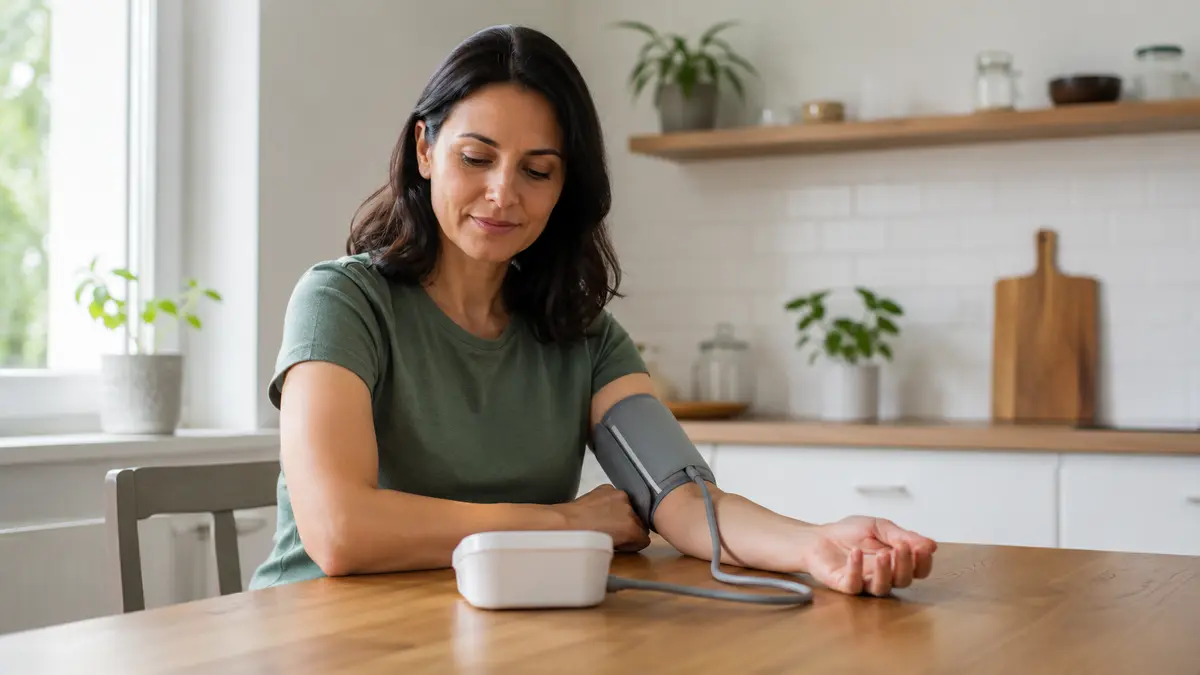
Even a validated monitor can mislead if the setup is inconsistent. The CDC guide to measuring blood pressure emphasizes quiet rest, supported posture, a bare arm, the cuff at chest height, feet flat, and no talking during the reading. These details are not etiquette; they influence the pressure being measured.
| Before or during the reading | Better practice | Why it helps |
|---|---|---|
| Recent food, caffeine, nicotine, or exercise | Wait about 30 minutes when practical | Reduces temporary influences on the reading |
| Full bladder or rushing | Use the bathroom and sit quietly first | Improves consistency from one session to the next |
| Unsupported back or crossed legs | Sit upright with back supported and feet flat | Limits posture-related measurement changes |
| Cuff over clothing | Place the cuff on bare skin | Improves contact and cuff inflation accuracy |
A Simple Reading Routine
- Set up the chair, table, cuff, and monitor before starting.
- Sit quietly for five minutes with the arm supported at about chest height.
- Take a reading without talking, scrolling, or moving around.
- Wait about one minute and take a second reading if your clinician has asked for paired measurements.
- Record the date, time, readings, and any useful context such as illness, medication timing, or unusual stress.
What to Record and What to Ignore
A home monitor can produce more numbers than a person knows what to do with. The goal is not to react emotionally to every single reading. Instead, look for patterns that can be reviewed with a professional. Recording a few well-taken readings is usually more useful than collecting dozens of hurried, inconsistent ones.
Do not change prescribed medication based only on a home device unless the prescribing clinician has given a clear plan for doing so. Do not start supplements, stop medication, or double doses because of a single reading. Safety note: blood pressure decisions can depend on symptoms, medical history, pregnancy status, kidney function, and medication interactions.
| Reading pattern | What it may mean | Reasonable next step |
|---|---|---|
| Occasional higher reading after stress or activity | May reflect temporary conditions | Repeat under proper conditions and log the context |
| Repeated higher readings over several sessions | May suggest a pattern worth reviewing | Share the log with a clinician for interpretation |
| Very high reading with concerning symptoms | Could represent an urgent medical situation | Seek urgent medical guidance rather than troubleshooting the device |
| Unexpectedly low readings with dizziness or fainting | Could reflect medication, dehydration, illness, or other causes | Contact a clinician promptly, especially if symptoms persist |
Common Technology Features: Helpful, But Not Proof
Modern monitors often include apps, cloud storage, reminders, irregular heartbeat alerts, multiple-user profiles, and automatic averaging. These can be useful, but they are secondary to validation and cuff fit. An app can make a bad reading easier to save; it cannot make the original measurement accurate.
- Bluetooth syncing can reduce transcription errors, but check that the synced numbers match the device display.
- Multi-user memory helps households avoid mixing readings from different people.
- Irregular rhythm alerts are screening prompts, not a diagnosis of an arrhythmia.
- Cloud dashboards should be reviewed for privacy settings, account requirements, and data sharing.
- Large displays and one-button operation may matter more than advanced analytics for older adults or anyone with vision or dexterity challenges.
Privacy Deserves a Place in the Decision
Blood pressure readings are health data. Before choosing an app-connected monitor, check whether the app requires an account, what data are stored, whether data can be exported without sharing with advertisers, and how easily another household member could see the information. For many people, an offline monitor plus a paper or PDF log is enough.
When to Bring the Monitor to a Visit
Bring the monitor to a clinic visit when it is new, when readings do not match office numbers, after replacing a cuff, or about once a year if the device is part of ongoing care. A clinician or trained team member can watch the technique, check cuff placement, and compare readings with clinic equipment. The AHA specifically encourages taking a home monitor to an appointment so its use and accuracy can be checked.
This step can also uncover simple problems: a cuff wrapped too loosely, an arm unsupported in midair, a device used on the wrist instead of the upper arm, or a log that lacks times and context. Correcting those issues may improve the quality of the data without changing any medical treatment.
When Readings Should Be Shared Promptly
Most home readings can wait for the next planned message or appointment, but some situations deserve faster attention. People should follow any personalized plan already given by their clinician, especially during pregnancy, after medication changes, or with known heart, kidney, endocrine, or neurological conditions.
| Situation | Why it matters | Action |
|---|---|---|
| Repeated readings far above the range your clinician set | May indicate poor control or technique problems | Share the log and technique details with the care team |
| High readings with chest pain, severe shortness of breath, weakness, confusion, or vision changes | Symptoms can signal an urgent condition | Seek urgent medical help immediately |
| Low readings with fainting, falls, or severe dizziness | May increase injury risk or reflect an underlying issue | Contact a clinician promptly |
| Pregnancy or postpartum high readings | Blood pressure concerns can become serious quickly | Follow obstetric guidance and contact the care team without delay |
A Practical Buying Checklist
The best monitor is not necessarily the most expensive one. It is the one that is validated, fits the user, is easy to use correctly, and produces data that can be shared with a clinician. Before buying, compare the exact model number against a validated listing, check the cuff range, and decide whether app features are worth the privacy tradeoffs.
| Question | Green flag | Reason to pause |
|---|---|---|
| Is the exact model validated? | Listed on a recognized validation resource | Only marketing language such as “clinically tested” |
| Will the cuff fit? | Arm circumference falls comfortably within the cuff range | One-size cuff with no clear range |
| Can the user operate it calmly? | Simple setup, readable display, stable cuff | Confusing menus or difficult cuff placement |
| Can readings be shared? | Easy log, export, or memory function | Data locked inside an app the user does not want |
Bottom Line
A home blood pressure monitor can be a useful wellness technology when it is treated as a measurement tool, not a medical oracle. Choose a validated upper-arm device, match the cuff to the arm, measure under consistent conditions, record patterns instead of reacting to isolated readings, and bring the monitor to a clinical visit for comparison when possible. The most important feature is not the app or the display. It is the trustworthiness of the reading and the ability to use that information safely with a qualified professional.
Sources
- American Heart Association: Home Blood Pressure Monitoring
- CDC: Measuring Your Blood Pressure
- Validate BP: Blood Pressure Devices You Can Trust
- Validate BP: Device Validation Process
- U.S. Preventive Services Task Force: Hypertension in Adults Screening
- JAMA Internal Medicine: Effects of Cuff Size on Blood Pressure Reading Accuracy